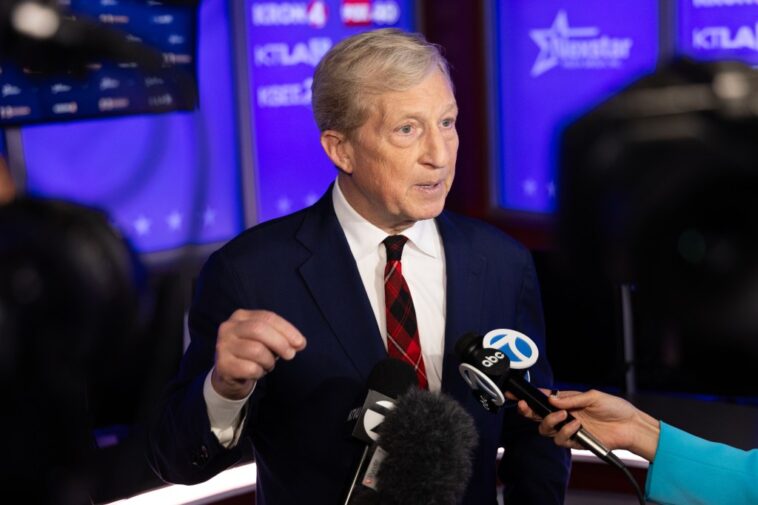
EXCLUSIVE: “As governor, I will do whatever it takes to preserve and advance California’s leadership as the artistic and creative powerhouse of the world,” Tom Seyer said Friday during a Burbank roundtable with labor leaders and industry advocates.
In one of the most fractured gubernatorial races in California history, the hedge fund billionaire and 2020 presidential candidate has emerged as a real contender to replace Gavin Newsom next year. Leaning hard into progressive causes and issues, Steyer is polling close to suddenly surging former Health and Human Services Secretary Xavier Becerra. A top finish in the June 2 primary could mean that Steyer would carry the Democrats’ banner into the fall election.
That race, in a very Blue California, could see Steyer face off against a Republican like Donald Trump-backed ex-Fox News host Steve Hilton or Riverside County sheriff Chad Bianco.
In anticipation of today’s sit-down in Burbank to discuss the production crisis that has seen a sharp drop in projects and entertainment jobs in the Golden State over the past five years, Steyer released a new Hollywood-focused ad and 10-point plan to preserve the industry and employment that shapes “art and culture across the globe.”
In addition to tax incentives, AI guardrails and more, Steyer in his plan takes aim at “mega-mergers like Warner Bros.-Paramount, which enriches executives and shareholders at the direct expense of working people.” He adds: Consolidation hurts working people and limits creative freedom. As Governor, I will support policies that not only protect jobs, but also ensure that Hollywood remains a place where independent media and creators are nurtured, celebrated, and rewarded.”
Before the roundtable, I spoke with Steyer, who already has been endorsed by IATSE, about the Paramount-WBD deal, Trump and the stability of Hilton, the production crisis, and what does California need to do to save the home of Hollywood.
DEADLINE: A lot of issues came up in this week’s debate, but interestingly enough, the ailments affecting the entertainment industry and workers here in Southern California and throughout the state did not come up. Do you think this is a priority for your fellow candidates?
TOM STEYER: You know, Dominic, I don’t know.
To me, this is a critical industry for Los Angeles. It’s a critical industry for California, supporting it and protecting it and allowing it to get back on a growth pattern. Seems to me to be, you know, an amazingly high priority. So I don’t understand if it’s not, why it isn’t, and I don’t understand why people didn’t oppose that stupid merger, because that thing is clearly anti-competitive and negative for the city, for the city of L.A. and for the state of California, no question.
DEADLINE: Well, let’s talk about that. On Friday, you’re holding a roundtable in Burbank, following the mock hearing on the merger and tax credits Sen. Adam Schiff had just a few weeks ago. WBD shareholders this week voted overwhelmingly for the merger to go through, though they did not vote for David Zaslav’s pay package, What should be done? What would you do if you were governor?
STEYER: I think the only thing what we can do is we can do an antitrust review in the state of California and try and block it based on state law.
The real problem here is this is not a close call based on antitrust. This is clearly anti-competitive. Honestly, this is not a close call. The problem we have is we have a corrupt president and a corrupt administration, and they’re basically trying to consolidate the entertainment and news industry under their posse and cronies.
They’re never going to enforce the antitrust laws against this, because they want to, you know, they want to have consolidation, they want to have anti-competitiveness. They want to control information in our society.
DEADLINE: Let me play devil’s advocate. Would you have felt the same way if Netflix had been successful in acquiring Warner Bros?
STEYER: I would have made the same judgment in terms of it being anti-competitive, yes. I would not have made the same judgment about the corrupt desire for these right wingers to try and control the news, which they’re clearly trying to do.
If Netflix had been successful, I would have made just a business judgment. Here, with Paramount wanting to own Warner Bros, it’s a business judgment and a political judgment.
David Ellison, the chairman and chief executive officer of Paramount Skydance Corp. at the State of the Union address in February
Anna Moneymaker/Getty Images
DEADLINE: On the business and political side, this week we saw $198 million in state tax incentives given out to 38 feature films as a part of the $750 million annual program. With that expanded program, as well as moves to have post-production incentives increased, what more do you think needs to be done to bring Hollywood back to the home of Hollywood?
STEYER: Well, let me say this, there are couple things going on, as I outlined in my 10-point plan. There’s the competition between us and other states, there’s the competition between us and other countries, and there’s a question about limiting this to $750 million.
DEADLINE: How do you mean?
STEYER: One of the things that’s true about this is this is not a cost. The tax incentives, which I think we need to expand, is an investment, and the investment pays a good return. So it returns more dollars to the state than it costs. So when we think about how much to do, this is not something that’s money out the door that’s never coming back. This is coming back, in fact, an investment that more than pays its way back. I think it pays back around $1.14 for every dollar that goes in.
DEADLINE: OK, then would you be open to doing something like in the state of Georgia, where they basically have an uncapped incentive program?
STEYER: I would be fine with that.
I would say, Dominic, if we’re going to do something like that, then there’s got to be some controls to make sure that we’re doing sensible things specifically. Because I don’t think anytime it’s good to just go like, you know, bombs away.
DEADLINE: True …
STEYER: I think we need to have some controls about how it’s done, but in terms of how much it’s done, as long as it’s going the way it is now, I think that we could definitely uncap the program. We need California’s program to be the most competitive in the world.
DEADLINE: Sure, but politics is perception as much as policy. What would you do on day one about getting production back to Hollywood?
STEYER: Really I would bring this question about the $750 million to the table. I would also want to do an immediate review of permitting regulations and logistics about filming. I know that we have some onerous permitting and regulatory parts about it, which is particularly relevant for smaller productions. And you know, we would want to start talking about what AI is doing to basically steal people’s creativity.
DEADLINE: In the rare spirit of potential bipartisanship, Donald Trump, Bernie Sanders, Adam Schiff, Gavin Newsom and more seem to have found this sweet spot where they all seem to agree that some sort of national tax incentive or national program could be helpful for production in America. The current governor has talked about something like a multibillion-dollar program. What do you think of that?
STEYER: Would I be happy if that happened? If, in fact, that would enable us to make sure we ensure jobs stay in Hollywood, and we grow the we start growing that pie again. Would that make me feel good? Yes, of course.
But let me say something else: I’m very skeptical of Donald Trump.
You know, watching what they’re doing about this Paramount-Warner Bros merger is a perfect example. I have not seen them do a single thing to help California, and I’ve seen them do multiple things to try and hurt us. So, would I be in favor of something like a national program, and I don’t know the details of it — I’d have to look. Would I trust the Trump administration to come in and, you know, really help us out – not yet. ,
DEADLINE: The post-debate reaction from this week has been quite mixed, but there is an overall feeling that nobody really delivered a solid punch. What was your take after being on stage with your rivals?
STEYER: Well, first I’m going to tell you about the election, then I’m going to tell you what I thought about the debate.
Look, I think this is a really simple election to me. I think there’s one person here who’s trying to stand up for working people, and that’s me. That’s that is where I think this election is, and I think it’s, from my standpoint, extremely clear.
I thought in this week’s debate, they didn’t ask the right questions, if you’ll excuse me for saying so. For instance, they didn’t ask about the film industry. They didn’t ask about health care. You know, they didn’t ask about climate change. There’s so many things that are critical. They didn’t ask about energy. So many critical issues for Californians that they didn’t ask about. And you know, the moderators were asking questions, you know, like should we be doing, language testing for truck drivers? How about should we have ICE agents terrorizing and racially profiling Californians? That’s another question. This seems like a much bigger question.
DEADLINE: So when you take that perspective, and obviously this has been a whirlwind of a campaign with twists and turns on all levels — Kamala Harris deciding not to run, the scandals and the exit of Eric Swalwell, to name a few. One of the oddest elements is ex-UK political operative and Fox News host Steve Hilton. Polls have the Republican, who has been endorsed by Trump, in the lead, or at the top. Which means, this race might end up being you and Steve Hilton. You were standing next to him at the debate, you actually chatted at points. What is your what is your take on him?
STEYER: The thing I think about Steve Hilton is he’s entertaining and he’s crazy.

L-R: Steve Hilton, Republican gubernatorial candidate for California, and Tom Steyer, Democratic gubernatorial candidate for California, fist-bump prior to the debate this week in San Francisco
DEADLINE: Reminds me of someone else …
STEYER: Yes, and just so you know, Dominic, he was in favor of extraditing a California doctor, Dr. Rémy Coeytaux, to Louisiana. Sending him there have him prosecuted under Louisiana abortion laws for prescribing medication. Yeah. I mean, he’s absolutely insane, absolutely insane.
DEADLINE: Shifting away from one type of insanity to the crazy and depleted situation L.A. and the state find themselves in with production, you’ve unveiled a program for the film and TV industry today and dropped a new Hollywood workers “We Work Here” ad. What do you want to get out of sitting down today with members of the industry?
STEYER: I really like to look people in the eye so that they’re really full people to me. To make sure that I’m hearing their story and taking it in and representing them fully. I can’t control what the voters do. I can’t control what Steve Hilton or, you know, Xavier Becerra does. What I do control is what I do.
DEADLINE: Which is?
STEYER: I want to faithfully do my job, which is to meet people in California, listen to them, get out as much as possible, see as many people as possible, and take in the information so that I can represent them, make sure I’m addressing their needs. And that’s the only thing I do.
So, for the roundtable, it’s exactly what I just said, Dominic: I am interested in meeting people, hearing their stories, hearing their concerns, so that I both understand the situation better. I want to be able to have stories in my head and understanding what people are going through, so I can do a good job making sure that it’s not just ideas, but it’s human beings that I’m representing, be it in the film industry or elsewhere in California.


GIPHY App Key not set. Please check settings