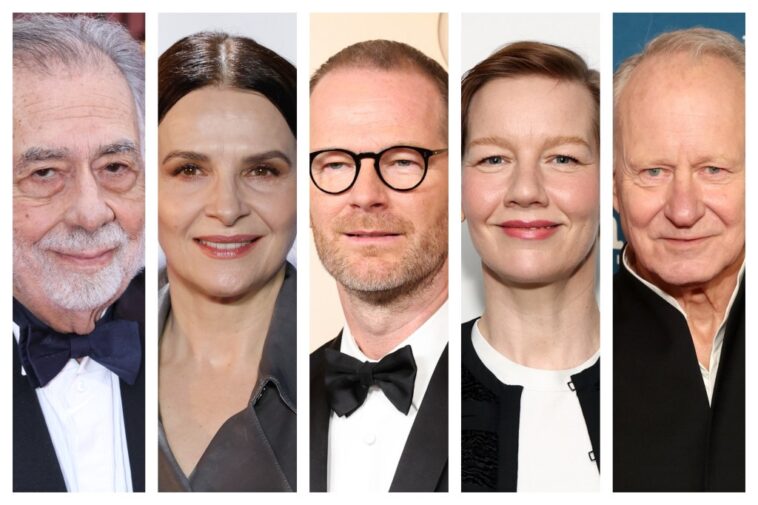
Juliette Binoche, Francis Ford Coppola Joachim Trier, Ruben Östlund, Stellan Skarsgård, Sandra Hüller and Vicky Krieps have joined calls for the European Union “to future-proof” the bloc’s 35-year MEDIA program which has supported thousands of films over the years.
They are among more than 4,700 cinema professionals to have signed an open letter entitled “Europe needs cinema, Cinema needs Europe”.
It has been published as EU Member states discuss plans for a controversial new mega-program bannered AgoraEU which will bring spending for culture, media and civil society under one umbrella. The move has set alarm bells ringing across the independent European film industry.
Under the proposal, the MEDIA program will be merged into a new Media+ strand combining support for film and audiovisual industries with that for video games, news media and journalism. MEDIA previously sat under the Creative Europe umbrella and ran several well-defined funding strands, honed over three decades, with clear multiyear funding windows.
The European Commission has proposed that €8.6 billion ($1 trillion) be set aside for AgoraEU under its 2028-2034 Multiannual Financial Framework (MFF) plan, with the European Parliament suggesting in April this should be bolstered to €10.7 billion under its ongoing consultation.
European film professionals say that while these figures suggests more money could be available overall for culture and media, there are no guarantees on what will be spent on the audiovisual and film sectors or any defined goals. The letter is part of a growing campaign to raise awareness around what is at stake.
“Just as the idea of Europe itself is a unique project, the idea of the MEDIA program is to sustain diverse European voices in a common house,” it reads.
“For over 35 years, it has been supporting the creation of European stories from script development to production by independent production companies, the releases in theatres and online, festivals, professionals’ training and upskilling.”
“We, European cinema professionals and citizens – all cinema lovers – call upon the European Commission, European Parliament and Member States to future-proof the success and integrity of the vital and precious MEDIA program and reinforce its resources. There are no shared values, no democracy, and no European soft power, without artistic creation.”
The member states are due to adopt a first position on the AgoraEU proposal on May 12, the same day as the opening of the 79th Cannes Film Festival.
The letter’s signatories include a number of Cannes habitués including 2026 Palme d’Or contenders Rodrigo Sorogoyen (The Beloved), Lukas Dhont (Coward), Pawel Pawlikowski (Fatherland) and Arthur Harari (The Unknown) as well as Ruben Östlund, Yorgos Lanthimos, Oliver Laxe, Michel Hazanavicius, Agnieszka Holland, Nadav Lapid, Laura Wandel, Ariane Labed, Agnès Jaoui, Clémence Poésy, Arnaud Desplechin among many more.
Most the signatories hail from Europe but the letter has also gained traction outside the region’s borders with Coppola among those lending his support.
The festival is usually a time of celebration for the MEDIA program thanks to its support of many of the European films in the Official Selection and parallel sections. This year, however, its future will be one of the hot button topics for European professionals up and down the Croisette.
Read the full letter below:
Cinema needs Europe, Europe needs cinema
“No art form, like cinema, traverses our diurnal consciousness so directly as to touch our feelings, deep within the twilight chamber of our soul.”
For more than 130 years, this twilight chamber, as Ingmar Bergman called it, was brought to life by the lives of others, by their thoughts, their struggles, their words and their gazes.
Cinema begins with the desire to create. It becomes a film through a succession of encounters: screenwriters, directors and producers develop it, cinematographers, actors, and technical crews contribute, film funds support it, sales agents and distributors bring it to cinemas and festivals – and later broadcasters and streamers, critics debate, and audiences embrace it.
Filmmaking is a collaborative art. It becomes an industry through job creation and technological innovation. Yet every film remains a prototype, impossible to mass-produce on an assembly line. There are no economies of scale in storytelling. This dual nature calls for deliberate political choices engaging public and private operators.
Europe itself, as a collective endeavour, was imagined in stories before it was built, it is Stefan Zweig’s continent of ideas, not armies. Cinema brought this imagined Europe to life: La Dolce Vita, Wings of Desire or Amélie turned Rome, Berlin and Paris into shared cultural references. Anatomy of a Fall, Sirat, or The New Years, global successes emerging from European talents, continue to build bridges across languages and borders.
In Europe, the political choice for cinema, be it Czech, Italian, Swedish, Slovenian, Portuguese or Belgian, is the MEDIA programme. Just as the idea of Europe itself is a unique project, the idea of the MEDIA programme is to sustain diverse European voices in a common house.
For over 35 years, it has been supporting the creation of European stories from script development to production by independent production companies, the releases in theatres and online, festivals, professionals’ training and upskilling. It has given a chance to all kinds of European projects, including the most unexpected ones, from East to West and from North to South. Building on the Union and Member States’ regulations, it has also reinforced our industries against global giants, allowing film professionals to face sector upheavals and resist standardization, and fostered a dynamic and job-creating ecosystem.
MEDIA is a drop in the ocean of European funding: it represents 0,2% of the Union’s budget, while, as a comparison, the common agricultural policy alone accounts for 32% of this budget.
Yet, it has been a European success story with an invaluable impact.
Thanks to MEDIA, works that nurtured the growth of Ruben Östlund or Justine Triet travelled the world.
Thanks to MEDIA, Europe wins an Oscar almost every year: after Flow, Gints Zilbalodis’s animated film, Joachim Trier’s Sentimental Value and the documentary Mr Nobody against Putin by David Borenstein and Pavel Talankin took the spotlight in 2026.
Thanks to MEDIA, the voices of exiled and oppressed authors, such as Jafar Panahi or Mohammad Rasoulof, have the freedom to reach audiences worldwide.
Thanks to MEDIA, our cherished neighbourhood cinemas can remain open to the world through diverse programming, and do not have to close their doors.
Without MEDIA, we would all be a little less European.
Greek filmmaker Costa-Gavras once said, “you cannot change people’s political vision with a film, but you can, at the very least, kindle a political discussion”. In times marked by war, geopolitical tensions, and pressure on democracy – our foremost common good – this function is essential. We strive to give our societies, our children and future adults a taste for collective experience, empathy, and resistance.
Yet Europe’s ability to tell its own stories is under strain. Most audiovisual productions viewed in Europe originate outside the continent. Global platforms increasingly shape visibility, access and stories. At the same time, the sector faces structural transformations: shifting audience habits, including declining cinema attendance, the rise of artificial intelligence, and growing geopolitical competition.
The European Union is currently revising the rules that enable European cinema to flourish, to travel, and to carry our common voice. It includes the future of MEDIA in the new AGORA EU programme.
It is now the time to write the next chapter of the European Cinema story, with even greater ambition, commensurate with the challenges we face. We must not fail to see that the destiny of democracy and that of cinema, both born in Europe, are intimately linked. Because every time a cinema opens, democratic life reasserts itself.
We, European cinema professionals and citizens – all cinema lovers – call upon the European Commission, European Parliament and Member States to future-proof the success and integrity of the vital and precious MEDIA programme and reinforce its resources. There are no shared values, no democracy, and no European soft power, without artistic creation.


GIPHY App Key not set. Please check settings