
If you purchase an independently reviewed product or service through a link on our website, Rolling Stone may receive an affiliate commission.
Jhené Aiko vibrates on a different frequency than the rest of the world. While reality leans toward hustle culture, Aiko’s music has often felt like an antithesis, bringing calm and reflective energy since 2011’s Sailing Soul(s) mixtape.
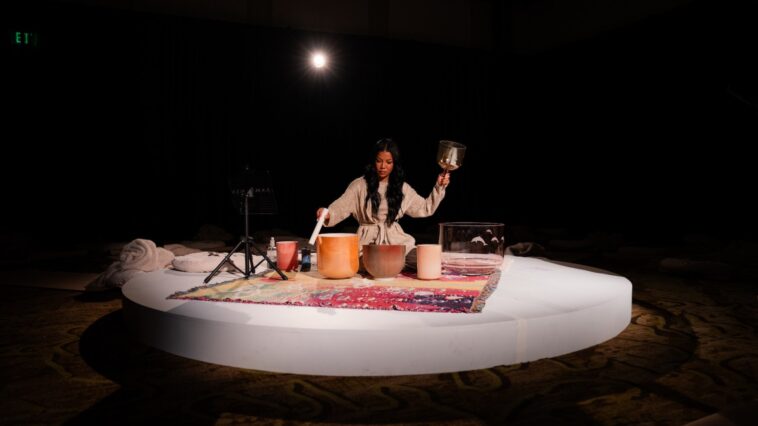
While she hasn’t released a new album of music since 2020’s Chilombo, Aiko has kept fans reminded of the importance of their wellness through social media. One scroll through her accounts and you’ll find positive memes about healing and being a Pisces, her offers to fans to be their therapist, and sound-bath videos that see her seated around large crystal bowls, conjuring healing sound frequencies from their rims.
With Velocity Black, a membership-based travel concierge service, Aiko was able to step out from behind the screens and the music booth to bring real-life wellness experiences to members. During a luxury wellness experience in California’s Napa Valley, offered to Velocity Black members, Aiko hosted a sound bath session using her own line of ALLEL bowls. “When I was younger, like a teenager, I got into Tibetan bowls,” Aiko says. “I loved how it felt to play them and listen to them.” In a darkened room infused with essential oils, Aiko channelled her teenage fascination into a group meditation, encouraging members to breathe in calm energy.
A day after hosting the sound bath with Velocity Black, Aiko talked with Rolling Stone about her first interactions with wellness, how having fun at Coachella was also self-care, and reflected on 10 years of Twenty88.
You’ve previously said that becoming a mother at 20 sparked your wellness journey. What was your idea of wellness before that, as a teenager?
My father is a pediatrician, and growing up, he always explained things to us from a very medical standpoint. But he’s also eccentric, so he would not only explain things to us in that way, he would explain things to us in a sort of fun way as well.
Then my mom and my grandmother are, I think, in their own right, like medicine women. And so they treated food as medicine. So when I was younger, wellness was really centered around what you’re putting in your body.
As I got older, it was more of like a physical thing, you know, feeling well physically. And naturally, as you get older, you start dealing with life and, like, big emotions and real-life situations, you get a little more concerned about the mental [side].
Do you remember the first wellness retreat you ever did?
My first wellness retreat that I ever did was in Mount Shasta with my beautiful friend Roxy. She hosted a women’s retreat. This was maybe about eight years ago? Yeah, it was great.
When did you begin to connect music to wellness and healing?
I’ve always been a writer. Since I learned how to write, I would have my mom sit with me [and] help me write out, like, rap songs. I was five or six the first time I sat down with her. So from an early age, writing has been a form of therapy for me to work out strong emotions and feelings, and I paired that with singing.
I put out my mixtape — when was that, 2011? — a lot of people would come up to me after that, and [say] “Oh, this song helped me with this and that.” I started to notice that pattern. So as I continued to make music, I just got more and more intentional with the sound.
When I was younger, like a teenager, I got into Tibetan bowls. I remember walking into the store with my dad, and they had a store that sold the bowls, and I remember, like, picking it up, and the owner of the shop was like, “Oh, you’re really good at that. Everyone doesn’t know how to play these.” My dad bought it for me, and then I just carried around with me and, you know, played the bowl in my room.
By the time I got to Chilombo, I was like, “Why am I not incorporating the sound bowls into my music?” I started studying the science of sound, and I came across Jeralyn Glass, who became my sound-healing mentor. She introduced me to the crystal alchemy sound bowls that are infused. Those are the bowls that I incorporated into the tracks on Chilombo.
It’s about just being more intentional with the music [and] still having fun, because I think that’s a big part of wellness — having fun and just really expressing yourself, not holding it in, but finding different ways to express yourself.
You brought up Chilombo, and fans are eager to hear what’s next for you, musically. There’s speculation about it being called Westside Whimsy?
“Westside Whimsy” is a lifestyle. It’s not a project. It’s a lifestyle. Everything I do is that — you’ll see.
Earlier, you said a big part of wellness is having fun. The world saw you doing just that recently on stage with Swae Lee and backstage with Sexyy Red at Coachella. How was that?
Coachella is always a good time. The first time I went to Coachella, I was just, like, general admission, me and my best friend, Chrissy. So to see it grow throughout the years has been really fun.
Swae Lee, we’ve been friends for a while. [“Mural”] is our third song [together] that we did on his latest album. Sexyy Red was in the same area, like her trailer was right next to Swae Lee’s. A random fact about her — her real name is Janae. So I was like, “I have to meet her, we have the same name.” I’m always trying to find my connections with people.
Twenty 88 recently turned 10. Did you celebrate it? What do you remember from that era, and is there anything you’d change?
Didn’t celebrate. I think that was a fun time in my life. That’s crazy that it’s 10. I think, if anything, it just puts time into perspective. How fast things change.
I wouldn’t change anything about it. That was, to me, a timeless project. What I loved about Twenty 88 was a lot of those songs were things I wouldn’t have done on my own project. So it was fun that I got to experiment with different sounds on that album.