On Valentines Day in 1962, millions of Americans tuned in for a never before televised event: a tour of the White House.
A Tour of the White House with Mrs. John F. Kennedy would go on to be viewed by a global audience of over 80 million in its initial airing. The black and white documentary was syndicated in over 50 countries, including the Soviet Union, and was a transformational use of American soft power through an emerging technological medium. It showed the seat of a still-young nation, powerful amid the post-World War II order, projecting an image itself not as the ostentatious shadow empire it would grow into, but as a noble, restrained republic cleaved to the egalitarian and anti-aristocratic principles of its founding.
The tour was a chance for the American public to view the large-scale renovation and historic preservation project that First Lady Jacqueline Kennedy Onassis undertook during her first year in the White House. It was, at its core, a measure of accountability — a way to show the American public, most of whom would never have the chance to see the Lincoln Bedroom or the Oval Office in person, what was going on in the people’s house.
“Can you make these changes according to your own personal tastes and desires?” CBS anchor Charles Collingwood pointedly asked the first lady.
“Well no,” Kennedy responded, “I have a committee which has museum experts and government people and private citizens on it. And then everything we do is subject to approval by the Fine Arts Committee.”
At the time, the renovations were funded through private donations, disclosed to the public via a published booklet. Individuals and organizations could give anything from money to artifacts connected to the presidency. But the committee and approval system the first lady implemented would lay a foundation of public transparency and accountability to the construction, renovation, and remodeling process for the White House and other federal buildings going forward.
It was a necessary change. More than a century after the nation’s founding, the post World World II economic revitalization had ushered in new construction practices, architectural schools of thought, and attitudes towards historical preservation in the wake of two devastating wars. The White House had already undergone several rounds of major renovations and a string of inhabitants that had turned its interior to a hodgepodge of differing tastes and styles. Older buildings in the capital were being renovated or outright torn down with little regard for their historic value or design. The nation, still young compared to many of its European allies, risked inadvertently erasing portions of structures built with a very specific intent: to transfer the philosophical principles of the American Revolution into the physical cityscape that would represent the American seat of governance.
Mrs. Kennedy went about her project with an intention rooted in those same attitudes. She sought to turn the presidential residence into a living museum through open collaboration with the public. Now, over 60 years since the Kennedys left the White House, the president is undertaking an architectural and aesthetic overhaul of not just the White House, but the city at large. The difference is that Donald Trump, a man who struggles to comprehend even the most basic tenants of representative governance, is looking to reshape Washington in his own gaudy, opulent self image — not that of the nation he is supposed to represent.
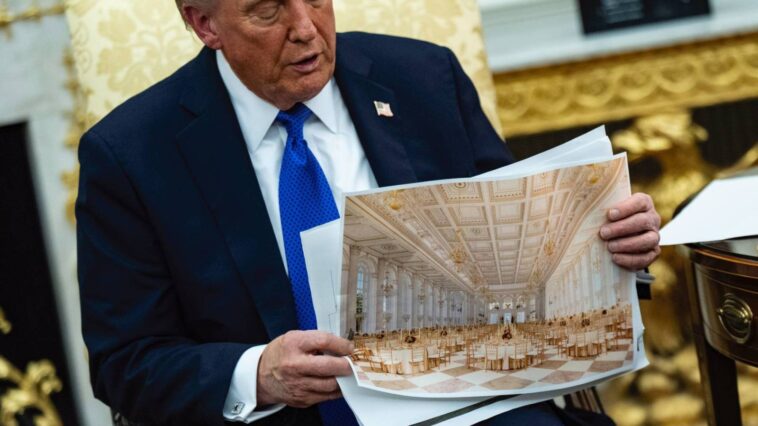
Trump has unilaterally authorized a series of construction projects and rebrands of major D.C. federal structures without authorization, fund appropriations, or oversight from Congress and the respective historical and preservation bodies that for decades have overseen major changes to taxpayer funded federal property. The destruction of the White House Rose Garden; the refinishing of the National Mall’s reflecting pool with a suburban swimming-pool blue coating; the co-opting of the Kennedy Center, a living memorial to one of the most consequential presidents in American history, into his personal theater; the gold leaf explosion in the West Wing; the redesign of the Lincoln Bathroom into a discount marble spa; the proposed construction of a giant arch on the bank of the Potomac; and perhaps most egregiously, the destruction of a whole wing of the White House to build himself a massive ballroom.
“He’s doing all this without review. It’s just spur of the moment, ‘What do I feel like today?’ And then he does it. And if we could just get him to pause and think about what it is he’s doing and the effects of that, I think this would go a long way,” Alison Hoagland, architectural historian and a trustee at the National Trust for Historic Preservation, tells Rolling Stone, giving the ballroom as an example. In the neoclassical style, “symmetry and hierarchy are very important.”
“The White House should always be the most important building on its site, building a ballroom three times the size of the White House is not going to let that happen,” she explains. “It’s going to take the eye, the weight of everything, all the attention off of the White House, which is this jewel in the center of the space, and push it over towards this oversized ballroom.”
The White House is one of the focal points in the physical layout of Washington, D.C., a city that was planned virtually from the ground up in the span of a few decades on the banks of the Potomac River. “It’s unique. It is a planned world capital, and it reflects democracy in the way that it’s laid out,” Hoagland adds. The original designer of the city, Pierre L’Enfant, “was very conscious of the vistas” and connected “certain sites, like the White House of the Capitol.”
L’Enfant put the Capitol on the largest hill near the Potomac River, and put the White House on another hill in order to create “a reciprocal view between them,” as Hoagland explains of the two buildings at the heart of the National Mall. She adds that the White House was intentionally designed as “a very domestic kind of building. It is not a palace — it’s bigger than probably your house or my house — but it’s sort of cloven to a country gentleman’s townhouse of the time.”
The White House, designed in a neoclassical style, is not overly ornamented, but rather restrained and dignified in its visual aspects — down to its color. The design was selected via an anonymous public competition, and George Washington lopped a whole floor off of the selected design to save money. A proposal for a significantly smaller structure submitted by future President Thomas Jefferson was rejected, but his insistence that the residence be styled a presidential “house” and not a presidential “palace” — as is still customary in many nations — stuck. Though the building shies away from the opulence expected of European rulers and monarchy, Jefferson would still go on to complain that it was still “big enough for two emperors, one pope, and the grand lama in the bargain.”
The Capitol is a “completely different building, and that is very deliberate” Hoagland says, noting that the imposing, ornate structure of the legislative building was placed in dominant physical dialogue with the executive residence as a reminder of which branch of government was supposed to loom largest — even though much our modern elected officials have seemingly forgotten.
That sort of intentionality is visible throughout Washington, D.C., although the casual tourist might not even realize it. To this day, buildings in the city do not surpass the height of the Capitol dome, meaning that any resident or visitor of the city is treated to a spectacular view of the major landmarks of the republic from virtually any moderately well placed rooftop. Even the times of greatest physical peril for the integrity of the United States are referenced in the landscape. Lincoln stares out towards the Washington Monument and the Capitol from his memorial, which is connected via a physical and metaphorical bridge over the Potomac River to Arlington Cemetery and the Robert E. Lee Mansion — the home of his Southern foe during the Civil War. The memorial was built as a visual reminder of the reunification between the North and South.
“There definitely was this very concerted effort to not be a monarchy, another D.C. historian and preservationist — who was granted anonymity to speak candidly on matters related to the president’s projects — tells Rolling Stone. “They weren’t quite sure what they were doing, because this was a whole new idea,” but it “was very much about things being democratic.”
“A philosophical statement was being made,” they add. “If we take that and extrapolate it to what’s happening now, there’s a philosophical statement being made that’s not consistent with the philosophy that had been previously in place.”
One need only look at the photos of Trump’s New York City penthouse to understand that the concept of architectural and decorative restraint have never entered the mind of Trump. The explosion of gold and crystal resembles the Hall of Mirrors in Versailles. Trump’s public image has long intended to convey the gaudy glitz and glamour of the nouveau riche, the stylistic trappings of a man who since birth has been able to purchase power, attention, and — in many cases — reverence. He’s doing everything he can to slather D.C. in tawdry extravagance, from covering the Oval Office in cheap gold finery to musing how he’s going to reimagine the marble in the Kennedy Center.
“His changes have been insults to the building,” Hoagland says of Trump’s hostile takeover of the monument to JFK, which he has tried to forcibly rename the Trump-Kennedy Center. The performing arts center was originally commissioned under the administration of President Dwight D. Eisenhower, and reimagined as a living memorial to Kennedy after his assasination. It was designed to be in dialogue with the Lincoln Memorial, a nod to another murdered president of tremendous importance. Trump slapped his name on the building, repainted the iconic bronze columns, has effectively taken over the center’s board and alienated a slew of major artists and productions, and — after protests and boycotts from artists and performers — forcibly closed the center for the next two years.
Perhaps even more objectionable is his commissioning of a “triumphal” arch at the base of the bridge connecting Arlington Cemetery to the Lincoln Memorial. The massive arch, styled after the elaborate ancient Roman and European arches typically commissioned to commemorate victories in major wars, is expected to disrupt the intentional visual connection between the Lincoln Memorial and Arlington Cemetery. You also have the element of the “memorial landscape on the Virginia side [of the river] that you’re putting a triumphal arch at the edge of,” Hoagland says. “You don’t put triumph and memorialization together.”
At the same time, there remains a question of what will happen to all these changes when Trump inevitably leaves office. “I think ideally, a lot of this could be undone,” Hoagland says. “The trouble is the cost, it costs a lot to tear down a building. Smaller things like the West Wing colonnade, could be fixed relatively fast. You just wait for the cycle of, you know, repair and change it out then.”
The memorials to presidents in Washington, D.C., tend to reflect the values they represent in the national memory. The Franklin Delano Roosevelt Memorial — a beautiful amalgamation of natural and structured elements set in an open air park — honors the former president’s four terms through a series of disability accessible open air rooms. Roosevelt Island, a wild sprawl of trials in the middle of the Potomac, embodies Theodore Roosevelets care for the innate beauty of the nation, and his role in establishing the National Park System. The Washington Monument, a beacon over the city, was designed to be “wholly American,” in its simplicity and stature.
Trump has, particularly with his ballroom project, designed the perfect embodiment of his time in office: a gargantuan, spiritually hollow structure that disrupts hundreds of years of carefully maintained history in service of one man’s ego.
“Trump is building a very Trumpian memorial to himself,” Hoagland says. If it is built, and remains standing, it will hopefully tell “future people, future citizens, about what happened during this time. He’s writing his own history on the landscape, as much as we try to object.”

GIPHY App Key not set. Please check settings