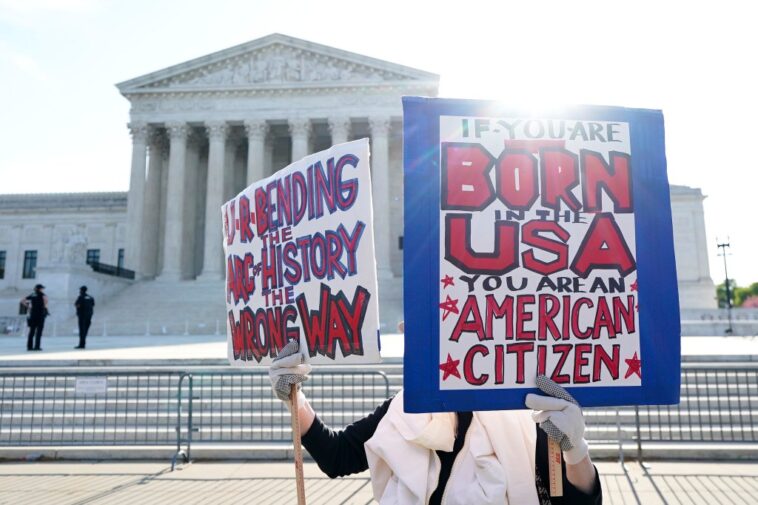
Donald Trump arrived at the Supreme Court on Wednesday to partake in something none of his predecessors are believed to have done: Attend an oral argument as a sitting president.
The case is his administration’s challenge to birthright citizenship. If the justices rule for Trump’s side, it will have a huge impact, as it long has been held that almost anyone born in the United States is automatically a citizen.
Last year, Trump signed an executive order that curbed birthright citizenship to children of undocumented immigrants and those in the country temporarily. The order was not retroactive, and applied to children born in the future.
The Fourteenth Amendment states that “all persons born or naturalized in the United States, and subject to the jurisdiction thereof, are citizens of the United States and of the State wherein they reside.” The Trump executive order claims that children of undocumented immigrants and temporary visitors “are not subject to the jurisdiction.” That is likely to be a major point of argument on Wednesday, as well as the Immigration and Nationality Act, the 1952 law that contains the same language.
A number of legal scholars believe that, even with a conservative court, Trump’s chances of prevailing are a long shot.
A federal judge blocked the executive order last year, in a class action suit filed by the ACLU.
The major cable news networks and C-SPAN carried live audio of the arguments. Cameras are not allowed in the Supreme Court chambers.


GIPHY App Key not set. Please check settings