
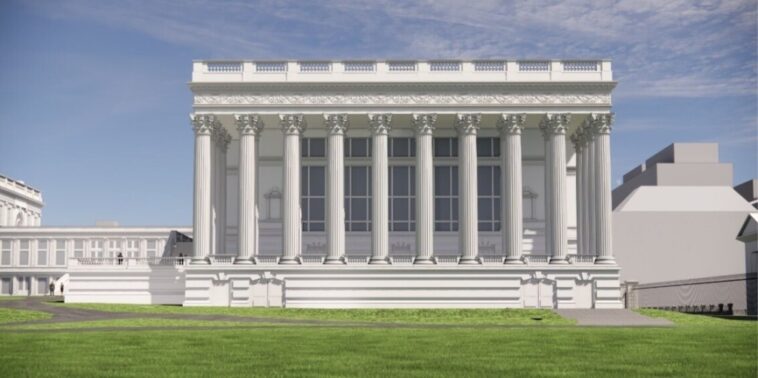
Donald Trump‘s proposed $400 million ballroom got approval from a key capital planning commission on Thursday, even though public comments were overwhelmingly against the project.
The greenlight from the National Capital Planning Commission came after a federal judge ruled that the project could not move forward without congressional approval, although that decision is being appealed.
Trump-appointed members of the commission, which is dominated by the president’s appointees, dismissed public concerns over the project, saying that many of the comments were beyond the scope of their purvue.
The chairman of the commission, Will Scharf, who is assistant to the president and White House staff secretary, defended the project, citing a long list of past changes to the White House and the surrounding area.
He said that many of the comments “dealt with issues beyond the scope of this commission, the private funding of the ballroom, for instance, or interior decorations, or the demolition process, or were simply opinions of the president himself. Considering issues of this sort is not within our mandate. We are not some sort of free-ranging ballroom justice commission.”
The Washington Post analyzed the 35,000 or so comments to the commission and found that 97% were critical of the plans for the ballroom.
But a number of architects and preservation groups provided their opinions of the 90,000 square foot project, generally characterizing it as way out of scale with the Executive Residence, the main part of the White House, while throwing off the symmetry of the grounds.
The architect revised plans slightly since the last commission meeting, removing stairs that would have extended from the ballroom’s south portico. As The New York Times noted in a recent story, the stairs would not have led to a door. Instead, the stairs have been reconfigured at the southwest corner of the ballroom, closer to an entrance.
Phil Mendelson, an ex officio member of the commission and chairman of the council of the District of Columbia, voted against the project.
“It’s just too large,” Mendelson said, characterizing the process as rushed following Trump’s demolition of the East Wing. He rejected the idea that landscaping could mitigate the scale of the new ballroom, saying that it was “not a solution.”
“It is possible to build a 1,000 person ballroom that, unlike the plan currently under review, truly honors the iconic status, the primacy and historic significance of the People’s House,” he said.
He noted that comments submitted showed how it could be done and, although smaller and lower in height, they would “preserve the material representation of the symbolic connection between the legislative and executive branches in a nation committed to representative government and public accountability.”
Trump has made the ballroom a priority of his second term, calling it a badly needed given the lack of large event space on the White House grounds. Private corporations and other donors will finance the project, he said.
The Commission on Fine Arts, although dominated by Trump appointees, signed off on the ballroom plans earlier this year.
Although the planning commission was the last commission review, the ballroom faces a new hurdle. Earlier this week, U.S. District Judge Richard Leon ruled that work on the ballroom had to stop until the project obtained “express authorization from Congress.”
“The president of the United States is the steward of the White House for future generations of First Families,” Leon wrote. “He is not, however, the owner!”
Scharf said that Leon’s order did not impact the commission’s ability to vote on the project.
Leon set his order to take effect in two weeks, enough time for an appeal, which Trump’s team has done.