
SPOILER ALERT: This piece contains spoilers for Netflix’s film adaptation of Shelby Van Pelt’s novel .
It took quite a team to assemble everything needed for Marcellus the octopus, one of the main characters in the Netflix feature film adaptation of Shelby Van Pelt’s novel, Remarkably Bright Creatures.
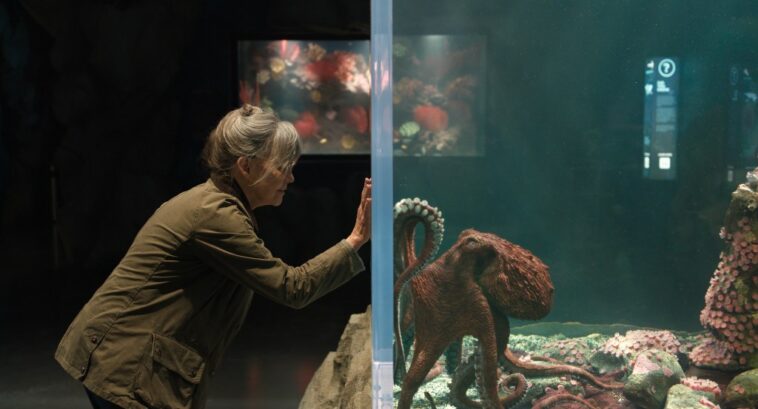
The film, which hews very closely to Van Pelt’s bestseller, brings together two curmudgeons of sorts — a widow, Tova Sullivan (Sally Field) and a Giant Pacific Octopus named Marcellus (voiced by Alfred Molina). The unlikely pair learn to care for each other during Tova’s shifts cleaning her local aquarium in the fictional Puget Sound town of Sowell Bay, Washington. Lewis Pullman’s character Cameron, whose band Moth Sausage is on its last legs when he arrives in the Pacific Northwest town, proves a good catalyst for both parties and a uniting factor for the story’s arc, which is narrated at times by Marcellus, who has a captivity countdown going as he nears the end of his life after an injury brought him to be “rescued” by the aquarium.
“I wanted to start with that image of Marcellus out in the wild, as he should be, in his happy place, remembering what is so wonderful about home, and then contrast it with where he finds himself now, which is kind of what all of the characters are going through in the movie as well,” director Oliva Newman told Deadline in an interview ahead of the film’s arrival on Netflix. “He really is, in many ways, a protagonist, because he goes on this journey of, he wants so badly to go home, and he thinks of humans as just being a detriment to what he wants. And then in having empathy for one of them and helping her, she actually recognizes what he needs as well and is able to give him what he needs by the end of the movie, too, and they both help each other find their way home.”
In the below interview, Newman, who also directed the Sony Pictures and Hello Sunshine feature film adaptation of Delia Owens’ Where The Crawdads Sing, walks Deadline through the process of casting Alfred Molina to voice the wise CGI octopus — who is not her first CGI-engineered creature to open up a film, meeting the “resounding response” of “more Marcellus” first cut feedback and more in her second nature-themed book adaptation.
DEADLINE: Was Alfred Molina always your ideal narrator? Were you involved in that search? Once he was confirmed, what did that look like?
NEWMAN: When we heard Alfred’s voice, we all had this sort of sigh of relief of “This is Marcellus.” I think everybody has a different voice in their head and trying to align it is hard. I knew that I wanted somebody who had a very sort of erudite quality, but I wanted Marcellus to be from the Pacific Northwest. That was really important to me, that he sound like he’s from the Pacific Northwest, whatever that means, and that he has real vulnerability and heart, even though he’s snarky, that you can still empathize with him. So it needed to combine all of those qualities.
It was really challenging to think of who would be, who would capture all of that. And when we landed on Alfred, and then when he said, “Yes,” and when we heard him in the booth for the first time, it was this collective sigh of relief. It was really hard to pick. I remember Sally [Field] saying it couldn’t have been any other way, like it just had to have been Alfred. I will say he was cast after I edited the movie, and part of that was because Marcellus was still coming together in the edits.
Sally Field as Tova in ‘Remarkably Bright Creatures’
Courtesy of Netflix
He was one of the characters that we kept adding scenes for him in post because when we were greenlit, we had to cut our budget down to get the green light. So a lot of that meant cutting down how much visual effects we were going to have in the movie, and so trimming down how much Marcellus was in the film. Then, of course, when we delivered our first cut, the resounding response was, “We want more Marcellus.” So then we had to create more scenes from the footage we had. And luckily, we had so much, so many plates and footage, that we were able to add him into scenes, and we could keep writing for him. I wanted to make sure that we found the full arc of the character before we got attached to a voice.
DEADLINE: I listened to the audiobook, and I know it’s Michael Urie voicing him. Was he considered at all? For readers who are used to his voice, what would you say?
NEWMAN: You know, I actually tried not to listen to the audiobook because I really, I didn’t want to have anything in my head, and I wanted the character to come to life through the filming process, through the writing process. I think he does a beautiful job in the audiobook, for sure. Alfred Molina’s voice was just right for for this context, that’s what I’ll say.
DEADLINE: Having helmed this film after Where the Crawdads Sing shows nature and wildlife as a theme in your work, at least for now. Is that something you actively look for in projects? What made you want to direct this one?
NEWMAN: I mean, maybe in 30 years I’ll have an answer because this is only two films. I have always been fascinated by being out in nature, by animals, by the natural world. I spent a lot of time as a kid playing in the woods. My dad built a little cabin with no electricity in the middle of the woods in upstate New York, and that was what we did for fun, was just run around the woods. That’s always held an important place in my life.
And then octopuses are the most fascinating creatures. I saw My Octopus Teacher and became absolutely fascinated by octopuses, and then I read Sy Montgomery’s Soul of an Octopus. So, when my producer sent me Remarkably Bright Creatures and said, “Tell me what you think. There’s an octopus in this book that has a voice,” and Sally Field is attached to play Tova. Picturing her while I was reading the book and imagining how I would show the world through the eyes of an octopus, through not just his visual world, his auditory experience, and finding a voice for him. Shelby creates such an incredible character in Marcellus that was definitely a huge draw for me to take this on. I was so excited to create an octopus character.


L-R: Sally Field as Tova and Lewis Pullman as Cameron in ‘Remarkably Bright Creatures’
Courtesy of Netflix
DEADLINE: You mentioned Sally. I’m curious about Lewis Pullman getting cast as Cameron. How did you want to balance their characters establishing that key relationship that’s one thing in the beginning, and then turns into this whole different layer at the end?
NEWMAN: Sally read with a few wonderful actors, and when Lewis came in and read with her, there was just undeniable chemistry. They felt like family, even in the way they argue. I think you see that in the movie the first time they meet. It feels like bickering family. He’s such an amazing improviser as well. Sally is one of the funniest people I’ve ever met, and Lewis can go toe to toe with her, which is not easy.
The minute he walked into the room and read with her. We all were sort of like, “Well, there’s Cameron.” We could just see it. I think what’s beautiful about Lewis as an actor is, he has those incredible comedic chops, but he also is such a deep-feeling human being [and] is able to really tap into his more vulnerable spots. He really isn’t afraid to, go there, and he likes playing. He liked experimenting, and we did so much of that on this film. So just the ideal actor to work with on this.
DEADLINE: Could you talk about shooting in the aquarium versus incorporating all those shots of jellyfish and creatures like you’re right there in the ocean? What was your strategy and how did you narrow down what to include?
NEWMAN: That was incredibly, incredibly hard. If I could have 30 minutes of just nature in every movie, I would, and then I always end up having to cut all of [it]. “We have too many birds,” was always the thing in Crawdads. We built an aquarium. It was really important to me that the whole world of the movie feel grounded in a real place. I did not want it to feel like a cartoonish, talking octopus movie. I wanted to make sure that we could cut between real octopus footage and our CGI, and hopefully not know which was which.
RELATED: Film Review: Best-Selling Book Adaptation ‘Where The Crawdads Sing’
We did six months of research and design to figure out how to tackle shooting an octopus. We realized early that we couldn’t shoot a real octopus because they will not be trained. They’re way too smart for that, and so we very quickly knew that we were going to have to create one from CGI, but wanted it to be as photo real as possible. So our visual effects team, led by the amazing Chris Ritvo, who should get all the flowers, they shot hours of footage of an octopus at the Vancouver Aquarium named Agnetha, a Giant Pacific Octopus, who we then give name an octopus at the end of the movie after.
Chris shot hours of footage of Agnetha, and then also just found hundreds of hours of real octopus footage online, and so every shot of our CGI octopus is based on an actual, real octopus, whether it’s Agnetha or research that they found online doing that, blocking those movements. So, nothing the octopus in our movie does is not something an octopus could do. Then we built an exact replica of her tank, and we built an aquarium set, and we put all real live fish, seahorses, eels, in our live aquarium, and we worked with an aquarium builder to make sure that the animals were all safe, and that when we were done shooting them, they could go back to where we got them from. So all the animals in our fake aquarium are real.
We also shot some footage at the actual Vancouver Aquarium, like the jellyfish tanks, the larger tanks, the shark tanks. So, we kind of built a set that we could sort of combine with footage from the Vancouver Aquarium. And then for the underwater ocean photography, we had an underwater photographer who went out with Chris Ritvo and got us exact plates and the exact camera movement that we wanted, that we knew we were going to put our CGI octopus into, because, again, we wanted Marcellus to always be filmed in a real place. We didn’t want to create a CGI underwater world. We wanted the underwater world, just like our aquarium, to be a real place that we were putting CGI into, so he would feel really grounded. We also had this incredible underwater photographer that my DP Ashley [Connor] found, named John Roney, who had shot so much beautiful photography all around Vancouver of octopuses and sea nettles and jellyfish, and he shared with us, basically his library of footage. We licensed footage from him to incorporate into the movie, and he was aware of the plates that we were shooting, and actually was incredibly helpful in helping our underwater photographer find the best places to go out and shoot the plates. So it was a real combination of effort to make sure that everything meshed.
DEADLINE: You adapted the script with John Whittington. Did you talk with Shelby [Van Pelt] at all? I know she came to set and was an executive producer, but how did you want to approach the adaptation, and keeping the spirit of the book while also injecting, you know, new ideas?
NEWMAN: Shelby read every draft of the script. John wrote the first couple of drafts, and when I came on as a director, then I took a stab at a couple of drafts. It was a process, and she read every single draft for both of us, and she was so supportive. I think she understood that the structure of a movie was going to have to take on something a little different than a book. I really learned that from Crawdads, that sometimes you have to move away from the structure of the book, but as long as you hold on to the characters and make sure that the DNA of the book is still in the movie, and that the emotional journey that the book takes you on is the same emotional journey that the movie takes you on, you want it to capture that feeling that readers loved while they were reading it. And Shelby was a great resource.
We did this talk at the L.A. Times Book Festival, and I don’t think she realized how helpful her notes were, even small details that she would pick up on that were inaccurate or wouldn’t make sense in the Pacific Northwest, she would call out, or remind us of aspects of the book that were really important to fans that we might have left out, so we needed to bring them back in. She was a huge resource, but she also was really supportive of us moving in any direction that we needed to make it work.
DEADLINE: There’s a point where Marcellus talks about blushing, and I’m curious how you went about that scene, because there’s another show with a trailer that recently came out, blushing is a theme in it. Is that special effects? How did you want to go about realistically showing that?
NEWMAN: Yeah, we did give them a little, we did add a little bit of color to get that across. It just occurred to me that octopuses change colors all the time, but usually it’s an instinct for survival. And thinking about how Marcellus sees the human species as so badly designed that the fact that we blush and we draw attention to ourselves when we’re actually feeling the most nervous and actually want to be hiding seems like a real design flaw. That felt like an opportunity for one of those human design flaws for Marcellus to comment on.
It was funny, because we were doing so much with color and color-changing with Marcellus that that was the one moment where we realized we had to do a little color-changing effects for our actors as well. We didn’t want to push it so far that it felt unrealistic. We just wanted to make sure that you could see it enough to register what Marcellus was registering.
DEADLINE: How did you approach filming the paddle-boarding scenes? There’s one where Avery pushes Cameron into the water. I’m sure the weather presented some challenges?
NEWMAN: It was not as bad as the weather on Crawdads, but the paddle board scene, that was really fun. We shot that on boats, and the water was quite rocky that day, which presented some real challenges. But the actors, both the actors, Sofia [Black-D’Elia] and Lewis, were completely game, and they had taken some lessons, and they had practiced, so they were somewhat comfortable. The water is very cold, but those wetsuits really kept them warm, we learned, after they went in.