
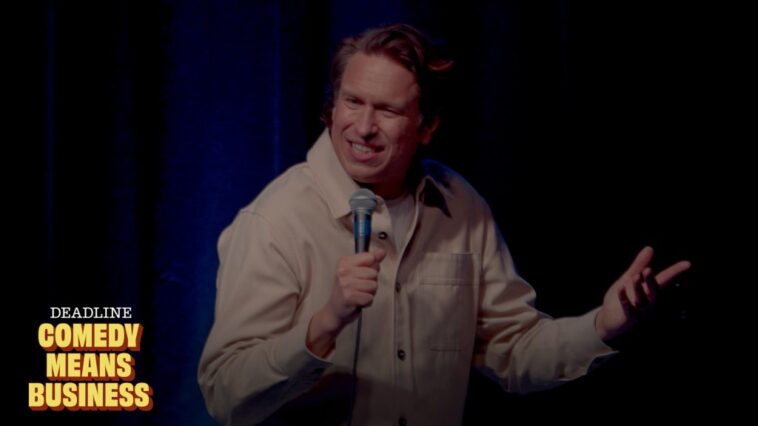
Attention, fans: Pete Holmes has reached “cruising altitude.”
Twenty-five years into his stand-up career, Holmes has settled into a new rhythm as a performer. He no longer wants to be a “rock polisher,” he says, grinding out three to four sets a night, as he did for many years.
In the interest of preserving his love for the craft, “I look at comedy like a cactus at this point in my career: I try to water it just as little as possible,” he explains in today’s episode of our Comedy Means Business podcast. “I’m really trying to dial it in. How can I have as much of a normal life and be with my wife and daughter as much as I can…but still do comedy?”
Coming off the release of his special, Silly Silly Fun Boy, Holmes resides 90 minutes north of Los Angeles and explains that he now tours one weekend a month, with two additional local spots between his longtime home at Largo at the Coronet and the Comedy Store.
As much as his priorities have shifted after becoming a family man, he’s quick to recognize when he’s not getting up enough on stage.
“I’ve noticed that on one hand, if I don’t perform enough, I get irritable. So there is a not enough,” he says. “And I love my wife so much. We’ll be at dinner, and I’ll be incapable of tuning the people out that are next to us. I’m neurotic. I’m like ‘This f*cking guy.’ She’s like, ‘Pete, you need to do a set.’”
A Boston native who began performing stand-up during his senior year at Gordon College in the early 2000s, Holmes came up through a version of the show biz landscape that no longer exists — and got as much out of it as anyone could.
Cutting his teeth in part through college gigs booked via the The National Association for Campus Activities, or NACA, Holmes went on to do multiple specials for Comedy Central — back when those were a thing — and further bolstered his momentum with late-night sets and festival appearances.
An early adopter of podcasting, who launched his show You Made It Weird just a few years after comedy podcast icons Mark Maron and Joe Rogan, Holmes found the show to be a major growth driver for his touring business, as it continues to be. He then gained more mainstream visibility as the host of The Pete Holmes Show, a late-night show for TBS, exec produced by Conan O’Brien, and as the creator and star of Crashing, a lauded, semi-autobiographical HBO series, chronicling his early stand-up years, after getting married and divorced early in life, as well as the evolution of his spiritual beliefs in adulthood, as he grew increasingly distant from, and eventually separated from, his lifelong identity as a God-fearing Christian.
While Holmes says that our current day is “a wonderful time for comedy,” he admits that he has some level of nostalgia for “the old way,” before the total destabilization/reinvention of the entertainment business that we’ve seen in recent years.
“I like the old way because it felt really special. That’s the underreported benefit of gatekeepers,” he says. “Like, I remember where I was when JoAnn Grigioni said, ‘You can do a Comedy Central Presents.’ When I’m in New York, I’ll sometimes be on that corner and I’ll be like, ‘Oh my God, this is where happened.’ You don’t get that feeling posting a TikTok clip.”
Experiences like these “make meaning,” he says, and he also enjoyed “all the pain and growth” that was demanded of comics, coming up the way he did.
In conversation with Deadline, Holmes delves into the disappearance of opportunities for talent incubation in stand-up and the impact of that, as well as his philosophy on stand-up today, which includes a “softening” toward crowd work at a time when audiences have come to demand it. He explains how jokes are like Amazon boxes and also talks about bombing at NACA, doing a warm-up act for The Daily Show, advice from younger stand-ups like Gianmarco Soresi and Rick Glassman that’s informed his approach to his business, and more.
Check out the podcast above.