UPDATED with additional quotes and details. In his first public comments since a federal judge blocked Nexstar’s merger with Tegna, Nexstar CEO Perry Sook took aim at DirecTV, one of the plaintiffs maneuvering against the $6.2 billion deal.
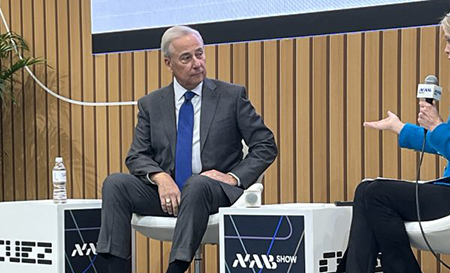
“The idea that anyone, Nexstar included, would be a ‘broadcast behemoth’ – to me, that term is kind of an oxymoron, given who we compete against,” Sook told Inside Edition host Debra Norville in a 1-on-1 conversation Tuesday at the NAB Show in Las Vegas. Amazon, Google and Meta, he added, “are multitrillion-dollar companies. Even DirecTV, which is one of the plaintiffs in the lawsuit, is twice the size of us. So [saying] we’re the ‘behemoth throwing our weight around in this marketplace’ doesn’t really reflect the reality.”
DirecTV, he added, has “a history of trying to weaken the companies it’s trying to negotiate with.” He said of the retransmission disputes resulting in blackouts in recent years, 83% of them have occurred on DirecTV systems. He also said that of the eight state attorneys general who also joined the lawsuit, six of them are up for election or re-election, making the effort to paint the Nexstar-Tegna deal as anti-competitive is a cynical ploy in an election year.
RELATED: Newsmax, DirecTV And Broadband Groups Appeal FCC’s Approval Of Nexstar-Tegna Merger, Call Out Trump’s Directive To “Get That Deal Done!”
Norville asked about industry consolidation, noting that Nexstar has grown in three decades from a single radio station in Scranton, PA, into the No. 1 owner of TV stations in the U.S. Sook invoked FCC Chairman Brendan Carr’s description of the financial state of the local broadcast industry being at a “break-glass moment.” He said he envisions “two or three companies” surviving to control all of local TV. “It’s a matter of time,” he said.
The lawsuit over the Tegna deal followed the March 20 announcement by Nexstar that it had closed the merger, soon after an order by the FCC Media Bureau granting relief from the federal ownership cap. The combined Nexstar-Tegna will have reach to 80% of U.S. household, more than doubling the current 39% level of the cap. While the massive local merger has unfolded in the shadow of the $110 billion Paramount-Warner Bros. Discovery combination, in some ways Nexstar-Tegna is the more transformational deal. It also carries the element of President Donald Trump and his FCC chairman, Brendan Carr. Both advocated for the deal to be closed before the FCC had weighed in on the cap and the Department of Justice had assessed potential antitrust issues.
RELATED: RELATED: Nexstar-Tegna Merger Cheered By Wall Street And Local TV Rivals: Are More Mega-Deals On The Way?
Norville asked Sook how long the deal likely would remain in limbo.
“We’re not in control of the timetable,” he said, after confirming the company is appealing the judge’s decision to the Ninth Circuit appellate court. “It will play out over a series of months here,” he said. “We have confidence that we will prevail on the facts and on the law and we’ll be vigorous in our defense.
The conversation put Sook through his paces, in large part because Norville has deep roots in broadcasting. Long before her three-decade tenure at Inside Edition began in 1995, Norville started as a reporter and anchor at WAGA-TV in Atlanta and WMAQ-TV before breaking into national news at MSNBC and NBC’s Today anchor. She posed to Sook a measured but pointed question about whether “a diversity of viewpoints” would be possible within single markets if Nexstar controls as many as three of the Big Four affiliates in a market, as will be possible after the Tegna merger.
“I think it’s a false dichotomy,” Sook answered. “I think it’s a false choice. People assume that the status quo, nothing will change. If we maintain the status quo, newsrooms will close. And I don’t close newsrooms. I just move the address and move them into one building, so I pay to heat and cool one facility. I may have one administrative staff, you know, one technical support staff, with two different studios, two sets of reporters, two anchor.” The aim, he said, was to streamline “rather than sending two reporters and two photographers and two company vehicles to cover the mayor’s press conference and they stand next to each other in the press pool.”
Sook said he has invested some $15 billion in scaling Nexstar through a series of M&A transactions and noted he is the third-largest shareholder in the company and has plenty at stake.
GIPHY App Key not set. Please check settings