
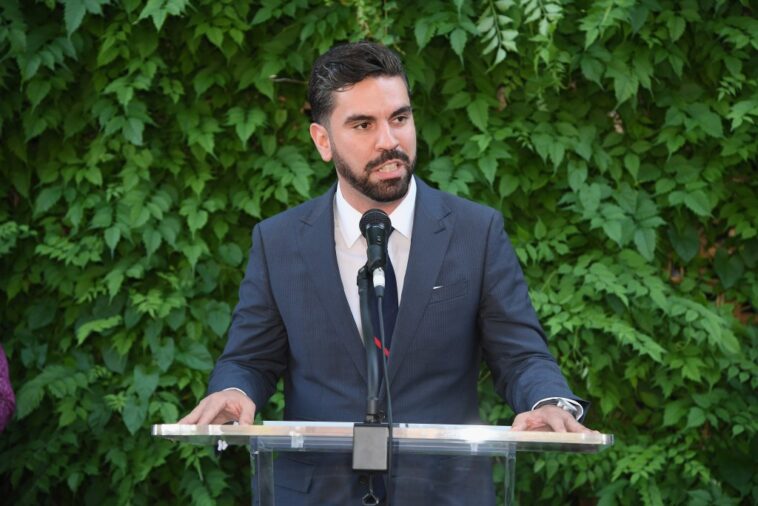
New York City’s ambitious administration led by Mayor Zohran Mamdani has a new Film Commissioner very much in the mold — youthful, aspirational and goal-oriented. Brooklyn-born and raised Rafael Espinal, 41, a Queens College graduate in English and film studies, became New York’s youngest elected official at age 26 when he joined the State Assembly in 2011. He served on the New York City Council representing Brooklyn, emerging as an advocate for workers and the creative sector and co-sponsoring the Freelance Isn’t Free Act, the first law of its kind to protect freelancers from nonpayment. He also led the repeal of NYC’s archaic No Dancing Cabaret Law and created the Office of Nightlife.
Just before Covid hit, Espinal became executive director of Freelancers Union, securing federal assistance for self-employed workers, creating the Freelance Relief Fund, and launching the Freelancers Hub in Brooklyn with coworking and resources for the media and entertainment community.
Now he runs the 100-person Mayor’s Office of Media and Entertainment (MOME) where he’s focused on investing in talent; supporting production; creating jobs; and building an economy where artists, storytellers and creative professionals can thrive.
Three months in, Espinal has streamlined the cumbersome permitting process. “We have one of the most competitive tax credits in the country now but it’s no secret that other cities and states are working to institute even stronger tax credits,” he said. “So I don’t think we’re going to tax-credit our way out of the decline in production generally across the country. We must create an environment where productions want to come. So we’re lifting the hood to see how we can do a better job, create a smoother more frictionless experience.”
He sat down with Deadline to chat about what’s he’s finding, what he’s doing, and his swerve from NYU film school to politics. [The Q&A has been edited for clarity.]
DEADLINE: It’s still early days but what did you find under the hood, what are your first moves?
RAFAEL ESPINAL: We’ve improved the permitting system. That’s already done. Cut down the amount of time it takes to get through it. There’s a better, easier user interface. We had a lot of complaints about the amount of time the process takes, the bugs and hiccups. So, people can now expect a much more fluid and easier process.
We are very action-oriented people so it’s not only about addressing the issues of today, but looking at policies that ensure that in the future, the city creates a much more frictionless process for everyone, that the agencies in charge of overseeing and enforcing the permits understand what is happening on the ground, cutting down the confusion.
One more thing, if you don’t need to shut down a street, if it’s just you and a camera, you don’t need a permit from our office, and we’ve made that easier, creating a new letter that’s available on our website. As long as you’re able to affirm that you are shooting with a minimum amount of equipment, you can download this letter with your production’s name and the date you’re going to be filming and use that as proof, especially when you’re interacting with the NYPD or other street enforcement agencies.
DEADLINE: There was big meeting with stakeholders a few weeks ago at City Hall. What was the takeaway?
ESPINAL: We had a roundtable where the industry was able to speak to issues facing New York City, with deputy mayors and agencies like FDNY, Department of Buildings, Department of Transportation there to hear concerns with a renewed commitment that we’re doing everything we can to make the city friendly and accessible for film production. We plan to meet, if not monthly, at least quarterly.
I think I bring a different lens because I was a former legislator and I spent a lot of my time triaging constituent concerns, so being able to bring that experience and understand who needs to be at the table to ensure that problems don’t escalate to a point where they are damaging to productions was very useful for this conversation. We heard from labor unions about worker-specific issues. We heard from location scouts about challenges they face on city streets. We heard from studio heads about how to improve the relationships between the city and productions.
It was a very comprehensive meeting, and I feel that the production companies felt heard, the labor unions felt heard, and City Hall was truly listening.
From left: SAG-AFTRA’s Rebecca Damon, NYC Film COmmissioner Rafael Espinal, City Council Speaker Julie Menin, SAG-AFTRA NY Local President Ezra Knight and Rep. Jerrold Nadler
Courtesy of SAG-AFTRA
DEADLINE: You said you can’t “tax credit” NYC out of a slowdown, but the sweetened incentives definitely help, especially the speedier payouts. How are you working that?
ESPINAL: Yes, it’s great. But what I’ve learned is that there many financiers and production companies that don’t understand the improvements to the tax credit, and because of that they are still hesitant to approve loans, financing for production in the city and state of New York. We’ve been hearing from indie producers that it’s still tough for them to secure financing to shoot here because there’s still that misconception that it’s too slow.
So, we’re going to be doing on-the-ground educational meetings, speaking to financiers directly, speaking to productions, companies directly about the improvements that have been made. That while, yes, in the past, it might have taken them several years to receive their rebate, with the new amendments that time has been cut down to one year.
I have meetings set up and we hope we’re going to start seeing more projects getting greenlit in the city of New York.
DEADLINE: Along those lines, thoughts about neighbor New Jersey, which just had a big film expo last week with Gov. Mikie Sherrill. It’s got new soundstages, a strong crew base and competitive incentives.
ESPINAL: I would say New Jersey is not New York City, right? New York City continues to be one of the major film hubs in the country because we have the amazing skylines, the beautiful sidewalks and the amazing storefronts that create great visuals on camera. So even though there are challenges here and challenges across the industry, it will continue to be the premier place to shoot your film. Beyond that, we have a very strong workforce, an amazing workforce, in large part because of the work that MOME has done over the years in training folks and getting them connected. We’re working on a new PSA now featuring high-profile New York filmmakers telling that story, why they love shooting here.
DEADLINE: There’s a foreclosure complaint against one of the city’s historic studios, Kaufman Astoria. Like others, it’s struggled (although it did nab The Devil Wears Prada 2). But I’ve heard occupancy is picking up generally heading into the second half.
ESPINAL: It’s definitely a challenge that we inherited, that this administration is inheriting coming in. The industry has been a contraction and because of that a lot of these stages and studios are seeing less work. But that’s the challenge that we are ready to take on moving forward, especially with some of the older stages. It’s part of figuring out how to do the work to ensure that New York City becomes the most attractive place to shoot. As for Kaufman, at some point, because the land is city-owned, there will be conversations about its future. I’ve going on studio visits. I was at Sunset on the far West Side of Manhattan where Dexter was shooting. I was at Eastern Effects in Brooklyn, where they had an indie film shooting. I’m heading to Wildflower Studios in Queens next week.


Michael C. Hall and Krysten Ritter in ‘Dexter: Resurrection’
Zach Dilgard/Paramount+ with Showtime
DEADLINE: You’ve mentioned that MOME could expand its porfolio to cover music?
ESPINAL: New York City is a huge music hub and there’s been very little attention given to that industry. I think there’s a lot more we can do as a city to create an environment where we signal to that workforce, to the musicians, that we’re serious about the contributions they make to the city as a whole. There’s no reason why we shouldn’t be going toe-to-toe with cities like Nashville in terms of what we have to offer to musicians. So we want to look into how we can help cultivate and foster that industry and its workforce. We’re still in the development phase, but it’s something I hope to continue as we move forward.
DEALDINE: Workforce development is a big focus for the administration. Are there new programs?
ESPINAL: For sure, we just launched the Moonshot Initiative, a partnership with a program called the Moonshot Pilot Accelerator, and we’re sponsoring one female writer in the city of New York to pitch a TV pilot to studio execs that green light TV shows at Hulu, at HBO and elsewhere. The deadline to apply is May 27. We’re really excited about that program. We are also setting funds aside to create a Made In New York Directors Program. We’re thinking it through. It would be first-time grants for filmmakers in low-income communities. That’s one program I’m really excited about because these are communities that have a tough time accessing financing or fundraising to shoot their first films. We’re doing a 20th anniversary celebration for Made in New York’s signature PA program this month.
DEADLINE: Could you talk a bit about yourself? You almost went to film school?
ESPINAL: I went to I went to CUNY, to Queens College, and they have a film program there and I studied TV and media. I decided to apply to NYU [Tisch School of the Arts] to get an MFA. I was out of college while I applied and was also looking for work and took a job with a City Council member, not knowing at all how local government works. I wrote his speeches, letters to constituents, overall correspondence. And I applied for NYU. I submitted some screenplays. And I got a note saying they needed my transcript, which CUNY hadn’t sent. Seems I owed $1,000 for a class and they wouldn’t release it. At the time, that was a lot of money for me. My parents are first-generation immigrants. Asking them for $1,000 to pay for my transcript was crazy. CUNY wouldn’t budge So no NYU, but I got into politics.

Rafael Espinal
Rob Kim/Getty Images for DFFNYC
I ran for office at 26 and served in the State Assembly. I went to City Council and served there for seven years, delivered on everything I promised my community. But I always had that itch, like, I need to find my way into into a creative space. So I took a role with the Freelancers Union and focused a lot on creative workers issues, contract negotiations, access to health care, all of these things. I had a little more space to start writing, so I wrote a few screenplays. I wrote, directed and produced my first short film last year.
And, just to close the loop, when I shared this story with the Mayor, he said the rule had changed and CUNY must release transcripts.
DEADLINE: What a story! So how did you find your way to MOME?
Well, my plan was to finally pursue my dream in filmmaking, right until this opportunity came up where I’m like, we have the right Mayor, whose policies I align with, who’s coming in at a time where our country is hungry for change. How can I best use my experience in government, and tie my passions for the creative workforce, for filmmaking in general, and marry those things to best serve the city? So, I have to say, this is my dream job. Every day it’s that way, it’s been a dream.
MOME is the liaison between the city’s creative industries and the city of New York, right? How do we make it easier for these industries to exist here, to thrive, to grow? What I find so special about this administration is that they want to honor that, and they also see the value in flipping the agency and centering on the workforce. How do we look at what the needs of the workers are? How do we ensure that, as we see growth in these industries, it translates to better paying jobs, protection from exploitation, and creating pathways and pipelines to access opportunities. And how do we diversify that creative workforce of the city?
Meanwhile, here’s what I want: A production comes, and they say, hey, I just had to call one person, and I got every single permit I needed. I didn’t have to jump around from the Parks Department to the FDNY to NYPD, because MOME was there and was able to support us every step of the way. And then they’re going to tell their colleagues in L.A. or wherever that New York City has become the best and easiest place to shoot your film in. That’s what you want. That’s the dream.