
Myspace, which launched 2003, ushered in a joyous time for social media, where users discovered their favorite new band and debuted their angular new haircut for their friends.
The story of the site, which was subsequently bought by Rupert Murdoch’s News Corp in 2005, is told in Myspace, a documentary directed by Tommy Avallone and produced by Gunpowder & Sky, the company founded by former MTV boss Van Toffler.
The film, which premieres today at the HotDocs festival, explores the rise of the site, which introduced top 8 friendships, and how it helped launch the careers of the likes of Katy Perry, Taylor Swift and Dane Cook, and influencers such as Jeffree Star and Tila Tequila.
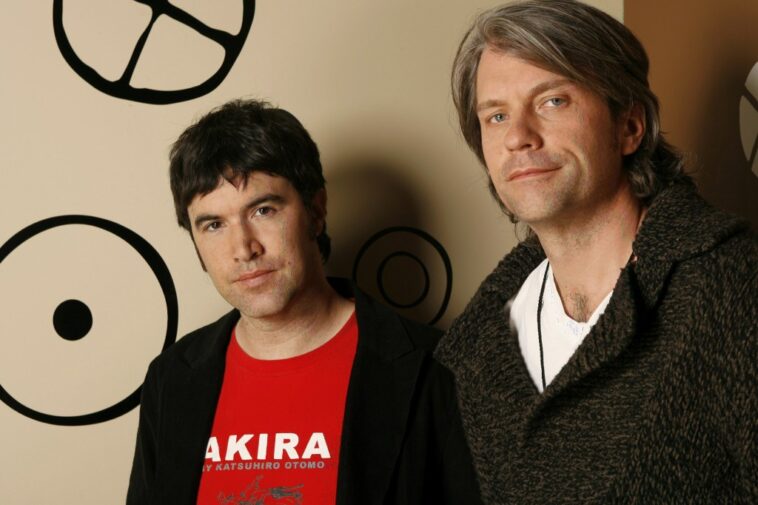
It was launched by Tom Anderson, otherwise known as everybody’s first friend, and Chris DeWolfe.
DeWolfe spoke with Deadline ahead of the documentary’s premiere. He said that the idea for Myspace was to be a place where users could “connect” and “express yourself”. “Your profile would be very much like your apartment or like your dorm room, that would have the music you like playing in the background and would have your top eight friends,” he said. “It really covered everything culturally from art to music to games.”
Myspace broke through in a way that no other social media site had previously done. DeWolfe admitted that it was a “wild” period.
“There’s a certain amount of fame and attention that you get for building the largest website in the world, that comes from out of nowhere that you have to deal with, along with building a very large company and expanding and selling the company and dealing with the political measures of a large company like News Corporation and Rupert Murdoch,” he added. “Most people settle into that over a 20-year time period and it all happened to me in probably less than six months to a year.”
DeWolfe said that Myspace had a “serendipity” that he believes it “almost impossible to replicate today”. He highlighted people being able to discover new musicians through the pages of friends or strangers. “It was social, it was a community, and you felt comfortable even talking to people you didn’t know, because you truly had something in common. It wasn’t a machine telling you to visit someone’s profile. You actually discovered it and felt like you had something in common,” he said.
“You were able to share those feelings or empathy, and that doesn’t really happen today. Today, it’s more of almost like a broadcast medium where everything is fed to you based on algorithms, as opposed to a certain intentionality that you would have on MySpace,” he added.
There were a couple of moments where Myspace and Facebook could have been part of the same company, talks that are documented in the documentary.
“There’s a lot of what ifs,” admitted DeWolfe. “Facebook could have gone the exact opposite direction if we had bought it after we were acquired by News Corp. If we had acquired it before we were we were bought by News Corp, I don’t know, maybe the culture’s would have worked together or maybe they wouldn’t have.”
He said that Facebook started out with a “very different vision” than Myspace but soon became a competitor.
DeWolfe also admitted that, in hindsight, he does regret selling the company to News Corp in 2005 for $580M. “There’s a lot of amazing experiences that I had at News Corp. I have great respect for Rupert Murdoch as an entrepreneur and everything he built, and I’ve learned a lot from him personally. I think with a large company, you don’t understand the ups and downs of every company,” he said. “I think if there had been more autonomy during the whole MySpace News Corp acquisition, we could have kept growing. I’m pretty self-reflective during that time of the mistakes that I made; we expanded too quickly into too many different areas, so I felt like we had a little bit of the peanut butter effect spread out into too many different ways, not focusing on the core areas.”
Murdoch had set aggressive revenue targets for Myspace including an aim for $1B in advertising revenue by the end of 2008. This was a different strategy from Facebook and YouTube, which had been acquired by Google in 2006, which didn’t have the pressure to monetize.
He compared it to a similar situation with A.I. companies now.
“The whole question is when do you turn on the monetization engine? For Facebook, it wasn’t for many, many years. For YouTube, it wasn’t for many, many years. Now, YouTube sort of owns the media landscape, and YouTube really built its business off of the back of users pasting their videos onto their Myspace profiles,” he said.
In terms of the documentary, Van Toffler, who runs Gunpowder & Sky with Floris Bauer, was part of the Viacom team that wanted to acquire Myspace but lost out to News Corp.
DeWolfe said that he’d stayed in touch with Toffler, who approached him four or five years ago about making a documentary. The film was made with The Documentary Group; Toffler produces alongside Trent Johnson with Ronald Frankel, Floris Bauer, Joanna Zwickel, Barry Barclay and Tom Yellin as exec producers and DeWolfe as a consulting producer alongside Josh Brooks.
He admitted that he was initially hesitant to tell the story; DeWolfe later founded successful video game company Jam City.
“My Myspace memories will always be huge. It basically defined social networks in terms of what they are today from digital distribution and music to the beginning of influencers. I’m very proud of all of those things but I’ve kind of moved on and am not living in the past,” he said.
But as the film shows, Myspace had a rocketing rise and DeWolfe noted people like Katie Perry, Kid Rock and Christina Aguilera coming into the office, and appearing on shows with Charlie Rose and Barbara Walters.
“You kind of forget about those things, and you say, ‘did that really happen?’ It’s kind of cool to reminisce about those things and remember that they happened,” he said. “Why were we considered fascinating in any way? It just doesn’t really make any sense to me. But fun to remember. It’s fun to reminisce, but yeah, for like five minutes.”