
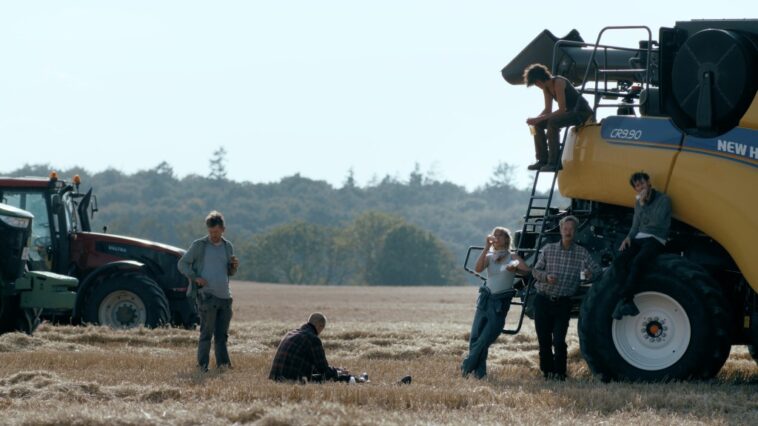
Land of Mine director Martin Zandvliet has just arrived back in Copenhagen after witnessing his debut television show, Harvest, premiere at Canneseries. Two episodes of the seven-part drama out of Denmark screened in competition, giving the audience an early taste of a show that hasn’t yet locked edits on later eps.
Billed as ‘Succession with tractors’ (not a moniker Vandliet is particularly fond of), the series stars the likes of Katrine Greis-Rosenthal, Elliott Crosset Hove, Lars Brygmann, and follows the story of a farming family at war. It kicks off when relatives gather to celebrate patriarch Gorm’s 65th birthday, but his decision to turn the family farm Feldumgaard over to his youngest daughter, Astrid (Greis-Rosenthal), bypassing his eldest son, Erik (Crosset Hove), tears the family apart.
Danish pubcaster DR and its in-house production division DR Drama are behind the show, which also has buy-in from the New8 European network financing club. Zandvliet is the writer, creator and director.
In an interview after the screening, he told us about the experience of making the show, distancing Harvest from the comparisons with HBO hit Succession. “Yeah, it’s a family in crisis because of a generation change, but this is a whole different atmosphere,” he said.
Zandvliet is best known for his Oscar-nominated 2015 movie Land of Mine, which was about the 1.3 million German landmines that were cleared from Danish shores and fields in the final stages of World War II. Harvest is an altogether smaller story, but still features the same vistas and is another meditation on Denmark and its history.
“It’s my responsibility as a filmmaker to make it visual,” he said. “Here, and on Land of Mine, it’s about the grand scale of it all.”
Deadline sat down with the director to talk through his experience following the world premiere in Cannes.
DEADLINE: How did it feel to screen the show at Canneseries?
MARTIN VANDZLIET: It was amazing for me and for the team to premiere it at Cannes, to see it on the screen and with the audience. I’ve never done TV before, but it’s not what you normally experience.
DEADLINE: How do you feel about this moniker that’s been attached to the show, ‘Succession with tractors?’
VANDZLIET: Harvest has nothing to do with Succession at all. Yeah, it’s a family in crisis because of a generation change, but this is a whole different atmosphere and a whole different kind of character. It’s not about money. It’s about harvesting, the climate and the environment. It’s similar in that sense that it’s about jealousy, shame and secrets, but what show isn’t about that? The resemblance is that it’s a family and generational change and how that ruins a family.
DEADLINE: Compared with the films you’ve made, such as Land of Mine, how different was it making this one? Do you feel it fits in with the canon of your work, or is this something completely new?
VANDZLIET: It’s something completely new, and then again, not, because I think my movies are always somewhat about family or the lack of family. It’s the same here. In Land of Mine, of course, you have the engine of the landmines underneath the sand and this is different because it’s just about people and their relationships. It has the same visual approach to – the beautiful scenery of Denmark. I like to make it as cinematic as possible, and I think it’s my responsibility as a filmmaker to make it visual. Here, and on Land of Mine, it’s about the grand scale of it all.
Nordisk
DEADLINE: Television tends to favor certain precincts – the hospital, the courtroom, the police station. We see these tropes over and over again, but there aren’t that many with a rural setting. While I think ‘quiet’ is the wrong word, there is a difference in pacing here to many TV shows.
VANDZLIET: Exactly. I’m trying to make show TV, but I would like to tell a story with no guns or car chases, about ordinary people that I can relate to and hopefully the audience will relate to. There’s so much craziness going on in the world that normal people with normal problems should be enough to entertain us. I think we succeeded in that, but it’s definitely not ‘fast-forward TV making’ in that sense. I don’t think double-screening is something you do here – you need to look up, because it’s in the eyes and in the mimics.
DEADLINE: The show has a certain visual style with the tractors, the big sweeping vistas and the Scandinavian skies. In terms of cinematography, what did you have in mind?
VANDZLIET: Of course, we didn’t have the finances that big directors have, but just to be able to get up in the morning, catch the early sun, the magic hours, and shoot against it [was great]. I think it’s our responsibility as filmmakers to make it as cinematic as possible, not just talking heads in living rooms and hallways. When you’re doing a farming show, you owe it to the audience to be 80% exterior. I was very fortunate with the network, DR Drama.
DEADLINE: Talking of DR, one of the things that I think really makes them and other Scandinavian public broadcasters stand out is they’re very keen on projects that have some that say something about society and trigger debate. Fair to say this one is making some big statements about the way things are changing in Danish society?
VANDZLIET: Definitely, because there’s a lot of pointing fingers at farmers. Of course, there should be, because of climate change and pollution, but we also agreed that this is not a political show. It’s to give people a chance to look at a family who lives in this environment and then perhaps create a debate afterwards. How do we solve this problem? We still want food, and we still want cheap food, so what is actually the best choice and how do we get people to discuss this without being awful to each other? Maybe it was time to make a show about that, because there haven’t been one. There were Danish movies in the 1950s and 60s, but they were all about funny people in the countryside. This is a kind of realism. The pride of being a farmer has kind of gone away. I think that’s sad, because we’re still a farming country. I mean, 65% of our country is farm.
DEADLINE: And DR was helpful in putting your vision together.
VANDZLIET: They could have been very controlling, but they were, they were very interested making my vision, which I’m truly happy about.

DEADLINE: Is there an intention to take Harvest into a second season and maybe more, or does it wrap with the first one here?
VANDZLIET: I hope for a second season, but it depends on how the audience fall in love with the characters. It’s all about the characters. If they can relate to them, it will happen. If they can’t, well, then it’s a that was it.
DEADLINE: You’re a feature filmmaker primarily, and this is a new step for you into television. How did you find the experience versus the feature film experience?
VANDZLIET: It’s funny because I’ve been thinking a lot about it. What was different about it? It’s a lot longer shoot. We shot for 121 days here, and in Land of Mine, for an example, we shot for six six weeks. This is a long, long journey, which I enjoyed. I love being on set, I must admit. I really, really enjoy it, but then again, it’s also, it’s a long period of your life. Ultimately, it’s the same pacing – you work just as fast. Maybe it was different in the old days, I don’t know.
DEADLINE: Do you have other TV ideas?
VANDZLIET: I have a few ideas [for more TV shows], and I have a few things in the pipeline, but I don’t know. It all depends on how this season how it goes.
This interview has been edited and condensed for clarity.