
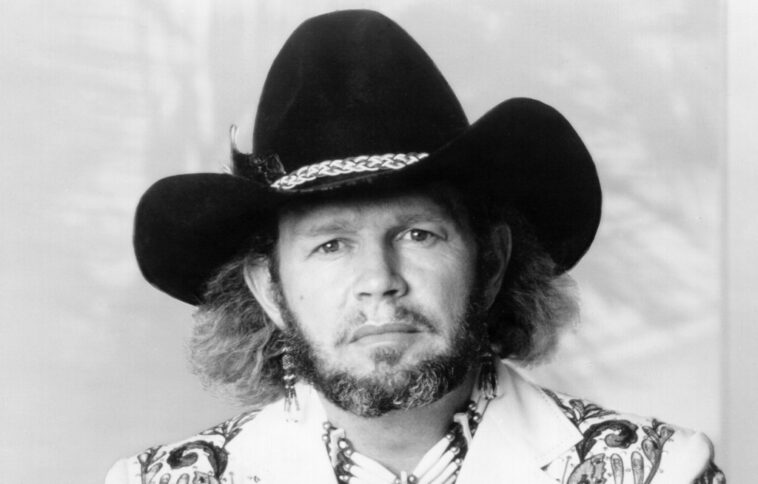
David Allan Coe, the country singer-songwriter who helped define Nashville’s “outlaw” sound of the 1970s and ’80s, and wrote “Take This Job and Shove It,” the song that would become the anthem of disaffected workers during the economic upheaval of the decade, died at a hospital Wednesday, April 29. He was 86.
His death was announced by his wife to Rolling Stone magazine. A cause and exact location of death were not disclosed. Coe reportedly was hospitalized several years ago with Covid-19 and had mostly retreated from public appearances since then, though it is not known whether Covid played a part in his passing.
Along with Waylon Jennings, Willie Nelson, Johnny Cash, Kris Kristofferson, Jessi Colter and others, Coe was a major part of the “outlaw country” movement that swept Nashville in the mid-1970s, offering listeners a rougher, rawer, more rebellious back-to-the-roots approach to country than the slick, string-heavy pop-ish “Nashville Sound,” or “Countrypolitan,” that had been dominant since the 1960s.
While Coe was a noted country singer in his own right, with hits, written by others, including “You Never Even Call Me by My Name,” “Tennessee Whiskey” and “Mona Lisa Lost Her Smile,” his most lasting impact was perhaps as a songwriter. His “Take This Job and Shove It,” with its smack-you-in-the-face opening lyric (“Take this job and shove it/I ain’t workin’ here no more/A woman done left and took all the reasons/I was working for”) was a massive and influential hit for the singer Johnny Paycheck in 1977.
The song was so popular that it inspired a feature film comedy of the same name in 1981. Directed by Gus Trikonis and starring Robert Hays, Barbara Hershey, Art Carney, and David Keith, the Take This Job And Shove It cast also included Coe and Paycheck in small roles.
Lacy J. Dalton and David Allen Coe in ‘Take This Job and Shove It’ (1981)
Avco Embassy/Everett Collection
Several years before “Take This Job…” became a smash, Coe wrote “Would You Lay With Me (in a Field of Stone),” a song that became a 1974 hit for a teenaged Tanya Tucker.
Born September 6, 1939, in Akron, Ohio, Coe did time in reformatories during his youth and, from 1963 to 1967 was imprisoned in Ohio for possession of burglary tools. His first album, 1970’s Penitentiary Blues, features songs he wrote while in prison. Four years later he recorded the album The Mysterious Rhinestone Cowboy, which he publicized by performing in a sparkly suit and a mask.
Unlike the more conservative, clean-cut country stars of the ’60s, Coe and the other “outlaws” took on a biker look – Coe himself had been part of a biker gang – that included long hair, beards, tattoos and cowboy hats. One of his hits, 1976’s “Longhaired Redneck,” summed up the image in one song title. The look, as well as the sounds, would make a lasting impact on country music.
Throughout his long popularity, Coe toured with Willie Nelson, Neil Young and even Kid Rock. Along the way, he wrote and recorded albums and songs that pushed boundaries with their racy lyrics, particularly on the 1978 album Nothing Sacred and 1982’s Underground Album. Sexually explicit, the songs also included lyrics that were racist and homophobic, songs he would later regret. In a 2001 Billboard magazine interview, he said, “Those were meant to be sung around the campfire for bikers, and I still don’t sing those songs in concert.”
In later years Coe had serious tussles with the IRS, causing debt, bankruptcy and the lost of publishing rights to even his biggest hits. His final album, in which he collaborated with heavy metal’s Dimebag Darrell and other former members of Pantera, was released in 2006.
Complete information on survivors was not immediately available.