
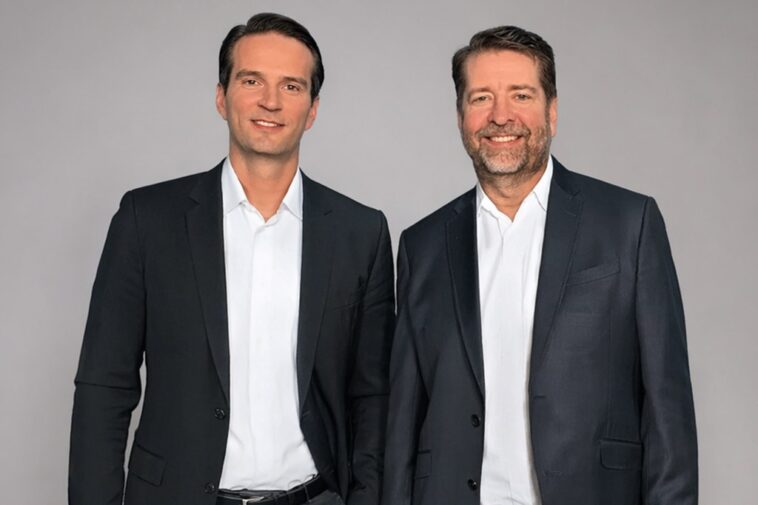
The seed for BMG and Concord’s agreement to merge into a recorded music and publishing giant with the kind of heft that immediately puts it in league with the majors got its start at Thomas Coesfeld and Bob Valentine‘s first meeting.
The duo became CEOs of BMG and Concord, respectively, on the same day — July 1, 2023. Soon after, they met for the first time to discuss their respective approaches to leading their rival but quite complementary independent music businesses.
“My takeaway from that initial meeting was how similarly we both thought about not just the industry, but how to build a modern music company,” says Valentine, who is slated to lead the combined BMG company if the deal goes through this year as expected, in an interview with Billboard. “We’ve got two organizations that have been built largely through M&A, and, you know, is there something that we could do together?”
It took several years and many more meetings to reach an agreement, but Coesfeld says they now have one in place to complete what would be the biggest music industry merger since the Universal Music Group bought EMI in 2011. “We have aligned shareholders, we have aligned CEOs, we have two great companies, and we have a very clear vision of where this company is headed,” says Coesfeld, who has been designated chairman of the future combined BMG and in January becomes CEO of BMG parent company Bertelsmann.
In this conversation, the two CEOs took Billboard inside their thinking about using AI in synch, keeping the Broken Bow Record name, company cuts and how their combined catalog provides a soundtrack to “a century-plus worth of nostalgia.”
Thomas, you’ve said you believe music companies must partner with competitors in this day and age. What does this partnership achieve and where may you still look for partners?
Thomas Coesfeld: There’s a lot of alignment between these two companies, but also between Bob and myself. We, over the past years, [have] spent a lot of time together and understand each other’s strategies. I think we’re going to be great partners on this.
Bob Valentine: Not only were Thomas and I aligned in the way that we thought about how to operate a new business, but I think over the last few years, our shareholders got to know each other and got comfortable with the fact that they were both thinking in very similar ways. We’ve had, for a long, long time, institutional investors. Pension fund investment is thinking about pensioners and the liabilities that they have over multiple decades. Bertelsmann has been around for 190 years — it’s a family-owned business.
Thomas Coesfeld: Both shareholders are aligned in patience of capital, long-term thinking, [and] a very distinct take on this industry.
What are your financial expectations for this new company? Why did the announcement only disclose EBITDA?
Bob Valentine: In the world we live in, having more scale in the industry matters. EBITDA is a shorthand for cash flow, and we have two shareholders who are entirely focused on generating cash flow and making sure that we have excellent margins. We’re not necessarily looking to be the biggest [music company]; we’re looking to be the most profitable.
Thomas Coesfeld: This company is and will be very profitable — probably the profitability and cash conversion leader in this industry. In addition, if you combine this with how much both companies have invested into music and IP over the past few years, you can tell this combined company will be very cash generative, very profitable. But the shareholders are committed to reinvesting a major chunk of that into the business.
What do you think about people calling you the next major?
Bob Valentine: I get it. The natural inclination is to look at the scale of business and compare it to the size of Warner, Sony, Universal, and say, “How does this fit in the ecosystem? How does this shift the ecosystem?” The word major gets thrown around a lot, and it’s fairly ill-defined at this point. It’s a code word for institutional scale and size. What [the new BMG] can mean in the ecosystem relative to the other three, is that it probably doesn’t share some of those historical legacy infrastructure kind of things that, in some respects, are valuable for the majors, and in some respects are challenging for them. This is absolutely an integrated music company that will take cash flow from our catalog and reinvest it vigorously into new songwriter signings, new recording artist signings, etc. So in that respect, we will be very similar to the majors.
Thomas Coesfeld: The market leader is still five or six times the size of this venture, measured by revenue. That’s just what it is. I’ve never been a big fan of this conventional distinction between the majors and everyone else. I think this new BMG is twice as independent. Call it major, call it indie. Doesn’t matter. It’s a very strong company, a very clear vision, with the means and nimbleness to invest.
Where do these companies overlap and what does operating “in a lean way” mean to you?
Thomas Coesfeld: It’s important that creators get their money fast. Lean means providing services and payment fast, effective and efficient, providing transparency and visibility about where things are streaming and things like that, because that’s what artists want to have handy in their app. And similar on the publishing side. This is one important building block of this company, and part of the strong alignment that we think if you have operations that work, if you provide services which are convincing, you have a proposition to make, you are creating competitive modes.
And if we go back to when we saw BMG implement some of these changes, that did come with some cuts in the form of layoffs. Do you anticipate that being replicated?
Bob Valentine: The reality is, whenever two companies come together of this size and scale, there’s going to be redundancies. That’s just the nature of corporate consolidation at the level that we’re talking about. But I do think when you look at these two companies, they’re more complementary than not. You’ve got a pretty U.S.-centric company here in Concord, with the Bertelsmann global footprint, and specifically BMG has a much larger presence in Europe than we have. I looked at it as pretty complementary. It would be unfair for me to say that there aren’t going to be some overlaps. But I really do look at the businesses and think there’s a lot of places where we and they aren’t necessarily in the same place and focusing, and that’s kind of where the growth can come from, I think, over the next five years for both businesses as they think about it.
Thomas Coesfeld: These companies share a vision, but more importantly, have a fairly similar strategy. With that we do have duplicate ventures. It’s a reality we won’t ignore. We have to make sure that we are honest, truthful and respectful in this process.
Describe what you want to develop in frontline at Concord Records.
Bob Valentine: To be a fully-integrated global music company, you need to have a vibrant, credible frontline business, both on the recorded side and on the songwriting signing side. I think Lucian [Grainge, Universal Music chairman/CEO] said the notion of frontline and catalog is outdated, and that if Justin Bieber is performing, if you’ve got Justin Bieber’s catalog, and you’ve got Justin Bieber performing at Coachella, you’re in the Justin Bieber business. In the world we live in today, the streaming algorithms don’t really differentiate between a record that just came out last week, and a record that came out seven years ago. So you have to think, if you’re going to be a fully-integrated music company, you’re in the business of that artist, and if that person’s releasing your music, it’s going to drive algorithmic discovery across [their catalog]. So when I say it’s important to have a frontline business, it’s important because you need to be in the business of the artists, and that could be somebody that you’ve acquired their catalog from 50 years ago. You still have to be able to connect that artist to a new set of fans.
Are Broken Bow Records, Stoney Creek, Fantasy Records, all of these iconic labels going to keep their names?
Thomas Coesfeld: We are absolutely committed to keeping those brands alive and to even making them more popular because this is what the artists are attached to, and also internally it creates identification. We will keep those brands alive, and even focus a bit more on what it actually means to be signed to BBR, to Stoney Creek.
Bob Valentine: It’s early days. These brands matter. They matter to artists. They matter to fans. So there has to be a thoughtful way that we integrate these two companies while we are maintaining the underlying brand value that exists for all these labels. It can be done, because we’ve done it. The majors do it all the time. You have to make sure that you don’t dilute the fundamental brand value they have from individual labels, while giving the notion that there’s a cohesive strategy.
How is AI being put to work currently and in the future?
Thomas Coesfeld: We have many instances where AI already today is a reality at BMG. In synch, we have agentic workflows where music recommendation for licensing and invoicing are fully automated. This does lower cost, but even more importantly, it improves the recommendation to, say, ad agencies or films. Say a new movie, series or documentary is being produced, we have this agentic process, which is recommending and then optimizing by certain dimensions, the suggested music. The combined company manages 4 million songs. There’s no way to go through an Excel list or to have anyone recollect that. You need technology.
Another [example] is catalog marketing. We’ve developed almost fully AI-generated and -operated YouTube channels, which are quite successful. We just launched it in January. It allows us to monetize the catalog, because you can’t have sufficient colleagues on the ground to create marketing campaigns for 4 million songs. You just can’t. It’s trial and error. What works, what doesn’t. You need technology underpinning your strategy.
Of course, there are risks. AI music can potentially cannibalize commercial music. So far, if you look at usage, both on Spotify or on Deezer, the usage is fairly low. It’s less than 10.1% of AI-generated music that is being consumed. So yes, there are risks, but there’s also plenty of opportunity with one fundamental rule: copyright comes first.
Bob, I’ve heard you say before that Concord owns the emotion and sound of the Vietnam War, through Fantasy Records and the catalog of Credence Clearwater Revival. Thomas, what big emotional eras does BMG’s catalog have the soundtrack for?
Thomas Coesfeld: That’s the beauty of this combined portfolio of music rights. You have big household names: Genesis, Phil Collins, Imagine Dragons, Tina Turner, Motley Crew if that’s more your style. Iron Maiden, Daddy Yankee, will.i.am., Buena Vista Social Club. The breadth of emotions associated with that is so rich that I think everyone can basically find the song of his or her life in BMG.
Bob Valentine: I echo what Thomas just said. I’ve called it rent on nostalgia. We really do have an attachment to probably a century-plus worth of nostalgia now in our combined catalogs. The amount of important life events that this catalog is attached to, from people’s weddings to their first date to their first Broadway show, the first musical I was in in seventh grade. I just can’t imagine that there’s a fan out there that we haven’t touched in some way with this catalog.
Thomas Coesfeld: It’s a big responsibility.