
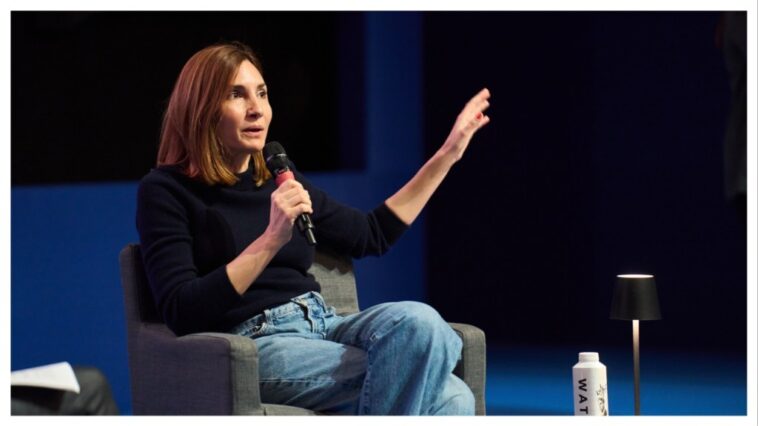
Audrey Diwan is no stranger to adapting books for the big screen with her films Happening and Emmanuelle both originating as novels. The French filmmaker touched down at Dublin’s Storyhouse screenwriting festival, where she discussed her approach to the writing process, collaborating with authors and the challenges of staying true to the original work.
“I used to ask the writer, ‘What are you trying to hide? What do you not want to say? And whenever you can name it, then you start the work,” Diwan told an audience at the Light House Cinema. “And you try to go to that place that you are avoiding because that’s why you would tell a story.”
She continued: “There are many, many books and films in history so why would anyone be a writer of anything? It’s not because you are you. Who cares, right? You have to define that secret place that hurts but is fascinating and also created by your own experience and your moment of grace and humiliation. That’s where it starts.”
Diwan teased her upcoming project The Marriage Portrait, a script that she is co-adapting from Hamnet author Maggie O’ Farrell’s 2022 novel of the same name. The project is being produced by Storyhouse founder Element Pictures alongside fellow Fremantle-owned banner Wildside.
“I would love to do this movie in the next year,” she said. “When Ed Guiney [Element Pictures co-CEO] sent me this book, I’ve since been asking myself the question, ‘What makes this book so important to me?’ And I tried very hard to create this intimate relationship with the book. The story is fascinating and you have to really find your own way through the story.”
Set in 1500s Renaissance Florence, The Marriage Story follows the fictional tale of young duchess Lucrezia de’ Medici, a sheltered 16-year-old who has spent her life locked inside the city’s grandest palazzo. But when her husband takes her on an unexpected visit to a country villa, it occurs to her that he has a sinister purpose and intends to kill her.
Diwan said that in order to be drawn to adapt material she needed “to be fascinated.” “I work with very, very different kinds of people on very different kinds of stories.”
She continued: “We are not artists to be perfect. We are artists to open doors and think of our own ideas. I don’t like comfort in what I’m doing.”
Diwan is a former journalist and when asked about her opinion on film reviews and whether or not she reads them, she said that “reading reviews is not really everything.”
“I like finding the voices and sometimes I don’t share their opinions, but I love the way they talk about films – I think that is very important,” she said. “There are some writers that I love and press that I trust. Obviously, I come from that world, and it would be so sad to have less people who comment and think about cinema in this way. There are beautiful writers and beautiful journalists who can really highlight things sometimes in your own work that you don’t see. I think that should exist forever and that’s very precious. In France, we have a strong culture of film critics and they’re important for a good reason and I think they will be protected because we need a strong voice in order to help us.”