
If you purchase an independently reviewed product or service through a link on our website, Rolling Stone may receive an affiliate commission.
Table of Contents
Noise-canceling headphones have come a long way since 1989. That’s the year Bose released the first commercially available active noise-canceling (ANC) headsets, which were originally designed for airline pilots. Many people still buy ANC headphones for the same reason they were invented — to reduce jet engine noise while on a flight. But these days, they’re capable of reducing distractions everywhere, from the office to train rides and even at home.
Given the fierce competition in the headphone market, noise-canceling headphones are expected to do more than just cancel background noise. Good sound quality is obviously paramount, as is comfort, particularly if you’re wearing them for hours on a plane. Other features to consider include microphone quality for calls, battery life, and travel-friendliness.
At a Glance: Best Noise-Canceling Headphones
Most ANC headphones also have an ambient or aware mode, letting in an amount of noise to keep you tuned in to your surroundings. But some, like Bose and Sennheiser, also let you further customize the ambient setting to your liking.
The Best Noise-Canceling Headphones
We’ve rounded up the best noise-canceling headphones on the market, ranging from budget-friendly models from under-the-radar brands to splurge-worthy audiophile-grade cans. For this guide, we focused on over-ear models, but if you’re looking for earbuds, we have guides for the best noise-canceling earbuds, best sounding earbuds, and best workout earbuds.
Best Overall
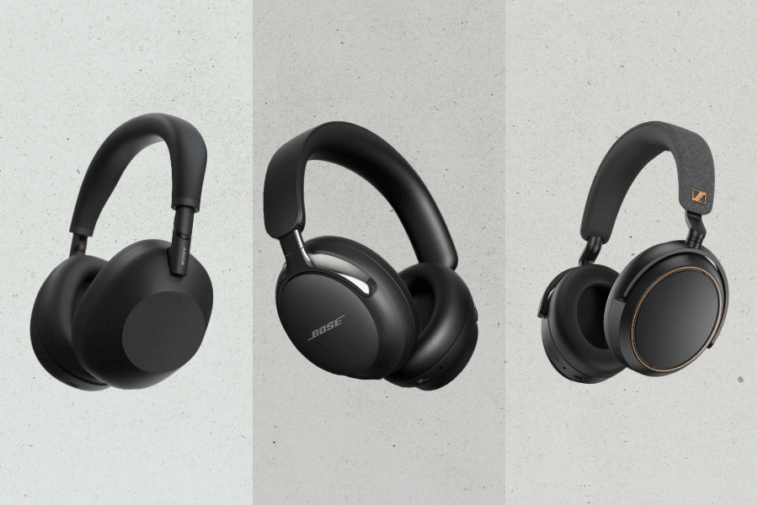
Bose QuietComfort Ultra Headphones 2
Quick Summary: The QC Ultras combine exceptional comfort and ANC with a stylish design and enjoyable sound for great all-around headphones, and the second-gen version features convenient features like auto power-on.
Stated Battery Life: Up to 30 hours (ANC on)
Carrying Case: Zippered hard case
Wear Detection: Yes
- Pros: Customizable ANC, great comfort, solid sound
- Cons: Pricey, hinges can creak
Simply put, Bose’s QuietComfort Ultra headphones have the best noise-canceling of any model I have tested. Not only is it the most effective, reducing sounds across a range of frequencies more capably than others, but it’s also highly customizable. You can create personalized modes in the app, with 10 ANC levels, which you can easily access using the headphones’ multifunction button.
The noise-canceling also automatically adjusts to sudden spikes in noise, and you can also turn off the ANC entirely if preferred. The headphones also live up to the “comfort” end of the QuietComfort name; the earpads are soft, but not overly cushioned, and the rounded earcup is a natural fit for the shape of the average ear.
Compared to the original QC Ultras, the second-gen model has a few handy new features. When you lay the headphones flat, they’ll automatically disconnect from your phone and go into a low-power mode. Put them on, and they’ll quickly wake back up and reconnect (there’s still a power button if you prefer to fully turn them off).
As for sound quality, the headphones are engaging and rich, although Sony and Sennheiser arguably offer a greater level of detail. Still, for everyday listening, these headphones are some of the best on the market, and arguably the best where noise-canceling is concerned.
Full Review: Bose QuietComfort Ultra Headphones (2nd Gen) Review: A Sequel Worth Paying Attention to


runner up
Sony WH-1000XM6
Quick Summary: Sony’s latest headphones are more compact and comfortable, while maintaining the audio performance and ANC of the XM5s.
Stated Battery Life: Up to 30 hours
Carrying Case: Magnetic hard case
Wear Detection: Yes
- Pros: Impressive number of features, better folding design than previous gen
- Cons: Bulky, pricey, app can be confusing to use, earpads could use more cushioning
There’s little daylight in the quality between Bose and Sony’s best headphones, which is why they’re so often mentioned in the same breath. I’d personally give a slight edge to Bose’s QC Ultras, simply because I find them more comfortable and I appreciate the aesthetics more. But there’s an easy case to be made for the XM6s being the best headphones to buy right now.
For starters, Sony redesigned the headphones so the earcups fold and rotate, a sticking point of the XM5s. Otherwise, they have a similar blocky design to the XM5 headphones. The case has been redesigned as well; it’s much smaller and has a clasp instead of a zipper. They’re comfortable, with a slightly wider headband than the XM5s and light, but with sufficient cushioning for all-day wear.
As expected from the XM series, the headphones have exceptional audio quality and ANC performance. The ambient mode is adjustable in the app, giving you greater customization of the ANC performance, although there aren’t the same customized ANC modes like Bose.
There are a ton of features, such that it’d be hard to list them all. Some are gimmicky (I’m not sure I need location-based ANC), while others can be genuinely useful, like speak-to-talk, which automatically pauses the music and switches to aware mode during conversations. These headphones also have a decent 30-hour battery life, a plus if you’re frequently on the go.
Full Review: The WH-1000XM6 Noise-Canceling Headphones Are Yet Another Hit From Sony
best sound
Sennheiser Momentum 4
Quick Summary: The design is bland, but these headphones boast great sound, ANC, and plenty of customization in the app.
Stated Battery Life: Up to 60 hours
Carrying Case: Hard zippered case
Wear Detection: Yes
- Pros: Long battery life, includes travel accessories, good sound and ANC
- Cons: Aesthetically plain, carrying case is big, sensitive controls are prone to accidental touches
Sennheiser’s Momentum 4 headphones are aesthetically bland, particularly compared to the retro good looks of the Momentum 3. But if you’re looking for a comfortable pair of headphones that no one is likely to ask you about, the Momentum 4 headphones tick a lot of boxes.
The hard zippered case is fairly large, but it has dedicated slots for the charging cable and audio cord, and it even comes with a two-pronged airplane adapter. The earpads rotate both inward and outward, although they don’t fold. Adding to their travel friendliness is the battery — we’re not sure where you need to fly where 60 hours of battery life is necessary, but it’s certainly a nice-to-have.
As for the controls, Sennheiser is all in on taps and swipes — there’s only one button on the headphones, which controls power and can be used for a voice assistant with one press. Like Sony’s headphones, swiping up or down controls volume, and forward and back skips tracks. A unique pinch control adjusts the transparency level, although this can be finicky.
The noise-canceling is great, although it’s not quite as good as Apple’s and Sony’s, but the customization features in the app are impressive. I tested out the wind noise reduction using a table fan pointed at me, and it did a good job at cutting the noise to a whisper.
In terms of audio performance, you get an impressive level of detail and clarity, and the EQ isn’t overly tilted toward lows or highs. There’s a five-band EQ in the app, but if you don’t want to play around with it, you can instead pick the “bass boost” or “podcast” modes.
Full Review: Sennheiser Momentum 4 vs. Sony WH-1000XM6: Top-Tier Headphones, Tested
best value
Cambridge Audio Melomania P100 SE
Quick Summary: Cambridge Audio’s Melomania P100 SE are a low-key hit from a storied audio brand, with great comfort and sound quality.
Stated Battery Life: Up to 100 hours
Carrying Case: Zippered hard case
Wear Detection: Yes
- Pros: Great audio for the price, easy tactile controls
- Cons: Bulky design and case, others have better ANC
Cambridge’s headphones may have a passing resemblance to another English headphone brand, Bowers & Wilkins, but the key difference is the price. At $300, the P100 SE significantly undercut rivals like B&W, Bose, and Sony, while still delivering great sound quality, solid ANC, and superb comfort.
If Cambridge has flown under your radar, it might be because the brand is best known for its HiFi home audio equipment, including its well-regarded speakers and amplifiers. But the brand has lately found success with portable audio, including its Melomania earbuds and headphones.
Where the P100 SE headphones make their mark is in battery life; these boast a whopping 100 hours of playtime, far outstripping the competition. The catch is that all that battery makes these some seriously bulky headphones. While they’re comfortable and surprisingly lightweight, they protrude significantly from the head when worn, and the case is very large.
Otherwise, the headphones have intuitive physical controls, with playback and volume on the right earcup and ANC and power on the left. There’s no 3.5mm headphone jack, but a USB-C to 3.5mm cable is included for wired listening.
Overall, the P100 SE is a sleeper hit for headphone value, with rich sound quality and ANC, great comfort, and jaw-dropping battery life.
best for iPhone
Apple AirPods Max 2
Quick Summary: While they’re only a slight upgrade over the originals, the latest AirPods Max headphones are still a worthwhile buy for iOS users.
Stated Battery Life: 20 hours
Carrying Case: Semi-structured magnetic pouch
Wear Detection: Yes
- Pros: Stylish design, outstanding audio, satisfying controls
- Cons: No EQ, limited customization, frustrating case design
Apple’s latest AirPods Max headphones didn’t come with any hardware upgrades, but the new features and subtle updates to sound quality and noise-canceling were enough for them to keep their spot as one of the best over-ear noise-canceling headphones on the market.
First, let’s address the bad. These headphones have a flimsy carrying case, so-so battery life, and poor utility with non-Apple devices. They’re also not very customizable, with no native options for adjusting EQ. Plus, there’s no 3.5mm headphone jack.
Despite these drawbacks, there are simply some of the most effective noise-canceling headphones on the market, cutting loud sounds down to a whisper. They also have a great ambient mode, allowing for awareness without compromising audio quality. As for the sound quality, it’s superb. Even without the ability to adjust the EQ, the headphones bring a variety of genres to life, with sufficient bite on the low-end without sounding boomy.
Of the new features, the biggest is a new adjustable Adaptive ANC mode that adjusts automatically to your surroundings. If you’re deep in Apple’s ecosystem, these will work well with your MacBook or iPhone, although there are better options for non-iOS users.
Full Review: Apple AirPods Max 2 Review: A Small Update to Already Great Headphones
Best Splurge
Bowers & Wilkins Px8 S2
Quick Summary: Bowers & Wilkins’ Px8 S2 boast a stylish design, excellent sound, and a more comfortable fit compared to the last generation.
Stated Battery Life: Up to 30 hours
Carrying Case: Zippered hard case
Wear Detection: Yes
- Pros: High-end design, great sound, useful tactile controls
- Cons: Very expensive, earcups aren’t user-replaceable
Bowers & Wilkins Px8 S2 headphones have a premium, luxurious feel, with a price to match. These are undoubtedly expensive headphones, but if top-tier audio quality and a high-end design are what you’re looking for, these headphones live up to Bowers & Wilkins’ reputation.
The headphones are the sequel to Bowers’ original Px8 headphones, released in 2022. And while the design is not a huge departure from the original, B&W made some worthwhile upgrades. The carrying case is more compact, and the headphones themselves are more lightweight, rectifying one of the main issues I had with the first gen.
If you’re partial to physical controls, the Px8 S2 features straightforward buttons on the earcups, with distinct volume buttons, a slider for power, and a multifunction button. The headphones have great noise canceling, even if it’s not up to the level of Bose or Sony, and the eight microphones in the headphones allow for clear voice calls. Ultimately, $800 is steep for headphones, but the Px8 S2 truly delivers a luxe listening experience.
Full Review: Bowers & Wilkins Px8 S2 Headphones Review: Top-Tier Audio, Top-Shelf Price
best controls
Bose QuietComfort Bluetooth Headphones
Quick Summary: These lack some features of the higher-priced QC Ultras, but the easy controls, great fit, and the ability to use them passively make them a worthy alternative.
Stated Battery Life: Up to 24 hours
Carrying Case: Zippered hard case
Wear Detection: No
- Pros: Light and comfortable, customizable ANC, intuitive tactile controls, can be used passively
- Cons: No wear detection, not as premium feeling given the price
Bose’s QuietComfort headphones don’t have the same refinement or features as the QC Ultras, but they’re still an excellent alternative to Bose’s flagship headphones. For starters, they have the same customizable ANC modes as the Ultras and great comfort for about $100 less.
The build is very similar to earlier QC 45 and 35 models. The earcups fold in and rotate, and the carrying case is compact yet protective, making these great for travel. Design-wise, they’re available in a range of poppy pastels, giving them a fun, youthful energy.
The physical controls are intuitive, with dedicated buttons for volume, playback, and ANC, plus a switch for power and Bluetooth pairing. I found the controls easier to familiarize myself with than the QuietComfort Ultras. Plus, these headphones can be used passively with the included cable, meaning you can plug them in on a long flight and conserve battery.
A few creature comforts are missing from these headphones, including wear detection; they lack features like Immersive Audio found on the QC Ultras and don’t look as high-end. Still, the noise-canceling performance is up to Bose’s high standards, as is the audio quality.
Full Review: Bose QuietComfort vs. QuietComfort Ultra Headphones: We Put Both to the Test
Also Great
JBL Live 780NC
Quick Summary: While these headphones lack a carrying case, they’re modestly-priced, comfortable, and have solid ANC and audio quality.
Stated Battery Life: Up to 80 hours (ANC off)
Carrying Case: Soft drawstring pouch
Wear Detection: Yes
- Pros: Stylish design, comfortable fit, good battery life, solid ANC and sound quality
- Cons: No carrying case, earcups aren’t removable, no 3.5mm cable
JBL’s latest over-ear headphones tick a lot of boxes for a moderate price. They’re comfortable and lightweight, but have enough padding for hours of wear. And while the design isn’t groundbreaking, they’re stylish, too, with availability in a range of monochrome colors.
The headphones have rotating, folding earcups, making them easy to store. A soft drawcord pouch is included, but there is no hard carrying case, which is a drawback if you’re primarily using these for travel.
As for the controls, these combine tap sensors on the earcup with tactile buttons for volume, ANC mode, and power/pairing. You can listen to them with a wired USB-C connection, but there’s no 3.5mm headphone jack.
They’re also capable at canceling noise, though not as effectively as Apple or Bose. These are also widely customizable; you can adjust the ANC and transparency level in the app, and the controls themselves offer plenty of customization options. Sound quality is solid, too; these don’t have show-stopping audio, but the profile is engaging and enjoyable, with some emphasis on the low-end.
There’s nothing that makes these headphones necessarily remarkable. There are cheaper options, better-sounding ones, and more effective noise-cancelers. But they do a lot of things well, with only a handful of tradeoffs.
best design
Nothing Headphones (1)
Quick Summary: The design is unusual, but the tactile controls and solid audio and ANC performance make these headphones a strong option from Nothing.
Stated Battery Life: Up to 35 hours (ANC on)
Carrying Case: Hard zippered case
Wear Detection: Yes (must be turned on in app)
- Pros: Playful tactile controls, good battery life, intuitive app
- Cons: Design will be divisive, no replacement earcups yet
Let’s get this out of the way — these are some weird-looking headphones. The retrofuturistic design is sure to be alienating (I’ve come to like them), borrowing design cues from the AirPods Max and cassette tapes, or something off Alien’s USCSS Nostromo.
The earcups rotate inward but don’t fold, and while the case is rather large, it’s slim. The headphones, despite their squared-off design, don’t protrude from the head too much, unlike Sony’s XM6 headphones.
The controls are satisfyingly tactile — there’s a volume roller that doubles as a playback/ANC control, a paddle to skip tracks, and a dedicated button for a voice assistant. The physical power switch is a nice touch as well, although the headphones are surprisingly easy to accidentally wear backwards.
In terms of audio, Nothing teamed up with venerated audio brand KEF, which tuned the sound. It’s solid and clear, although there’s not as much separation and detail as with Sony or other higher-end headphones. Still, for $300, they’re about $100-$150 less than flagship headphones from Sony and Bose.
Full Review: Nothing Is Onto Something With Its First Over-Ear Headphones
most compact
Beats Studio Pro
Quick Summary: The lack of wear detection is a flaw at this price, but these headphones deliver good ANC, sound, and battery life.
Stated Battery Life: Up to 40 hours
Carrying Case: Soft zippered case
Wear Detection: No
- Pros: Fun design, compact carrying pouch, good battery life
- Cons: Not as comfortable as others, no wear detection
There’s a slight caveat to this endorsement. For the full $350 list price, there are better options out there, but they’re a great option for the frequently on-sale price of $200 to $250. The headphones have a stylish yet inconspicuous look, and there are plenty of colors to choose from.
The headphones fold, but the earcups don’t rotate. Still, they feel more compact than other options. Instead of a hard case, you get a zippered pouch that almost resembles a toiletry bag. I was surprised by how much I liked the case, thanks to its compact size and inner organization for cables. Comfort-wise, they’re somewhat stiff, with shallow earcups. They’re not uncomfortable, but comfort is not the strongest suit of these headphones.
Like most Beats headphones, these feature physical controls, rather than touch controls. Pressing the center “B” logo controls playback, while pressing the ring above or below controls volume. The power button doubles as a multifunction button for ANC. The ANC performance is solid, capably blocking out a variety of noises. The stated battery life of up to 40 hours is impressive as well.
Audio performance is solid as well, and you can use a USB-C cable to stream lossless audio, though, like most Apple products, there is no option to customize the EQ. Overall, these are a solid option for both iOS and Android devices, and particularly for iPhone users who want the convenience of Apple’s ecosystem without shelling out for the AirPods Max.
best budget
OneOdio A6
Quick Summary: For less than $75, you get great battery life, impressive ANC performance, a stylish design, and a comfortable fit, although there are sacrifices on audio performance.
Stated Battery Life: Up to 75 hours
Carrying Case: None
Wear Detection: No
- Pros: Affordable price, long battery life, comfortable fit
- Cons: No carrying case, sound quality is only decent
Sometimes you don’t want to blow half your month’s rent on a pair of headphones. We get it. OneOdio’s A6 noise-canceling headphones are an affordable option. There are inevitable trade-offs at this point, but for about $70, you get a decently stylish, comfortable pair of headphones with surprising ANC performance.
The headphones fold and rotate, making them compact, but you’ll need a separate carrying case — these don’t come with one. The physical controls could also be better; the buttons are small and close together, although it is nice to have separate controls for volume, ANC, and power. There’s also no wear detection, so these headphones won’t pause when you take them off.
Despite these drawbacks, the ANC is impressive at this price point, cutting loud sounds to a whisper and outperforming some much more expensive headphones. The audio quality is somewhat flat, but it doesn’t sound as distant or tinny as some cheaper headphones.
Overall, if you’re looking to spend well under $100, these headphones are tough to beat.
How We Picked the Best Noise-Canceling Headphones
All of the options on our list were hand-tested. We prioritized factors that are hard to evaluate without hands-on testing, such as comfort, fit, and sound quality, while also looking at the spec sheet for factors like battery life, Bluetooth codecs, and more.

Clockwise, top left: Sennheiser, Nothing, Sony, Beats
While it would be tough to test every option on a plane without burning through some serious miles, we tested the noise-canceling in real-world (flights, busy streets) and simulated (table fans, loud TVs) settings, all to see how well they handle a variety of distractions.