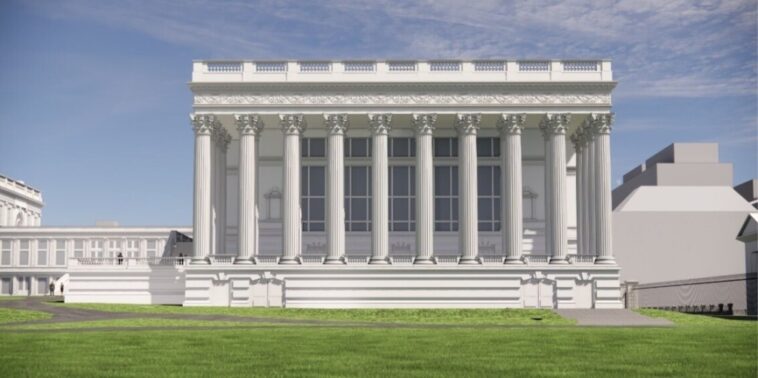
Donald Trump is pointing to the shooting at the White House Correspondents’ Dinner to make the case to a federal judge that he should lift his order to stop construction of a new White House ballroom.
The argument is that the incident never would have happened had the event been at the White House, which currently has a much smaller space, the East Room or outside tents, to host large events.
In a new filing late Monday, much of which reads like one of the president’s Truth Social posts, Justice Department attorneys argue the judge should never have stopped the project, “but after the Saturday night attempted assassination, which could have never have taken place in the new facility, reasonable minds can no longer differ — the injunction must be dissolved.” The DOJ lawyers also argue that the injunction “greatly endangers the lives of all presidents, current and future.”
The calls to get the ballroom built started shortly after Trump, First Lady Melania Trump and other administration officials were rushed from the Washington Hilton event space after shots were heard from an adjacent lobby area. On Monday, Cole Tomas Allen, 31, was charged with attempting to assassinate the president, along with other crimes, after he rushed through a security checkpoint carrying a rifle. That led to shots being fired, including one that struck a Secret Service agent, who was unharmed because he was wearing a protective vest.
U.S. District Judge Richard Leon ruled that while construction of an underground bunker, below the proposed ballroom, can continue, Trump needs approval of Congress to build the ballroom above it.
The DOJ’s latest filing starts with an attack on the National Trust for Historic Preservation, which brought suit to halt the ballroom.
“The are bad for the country,” the DOJ attorneys say in the filing about the National Trust. “They stop many projects that are worthy, and hurt many others.”
The Trump administration already has appealed Leon’s order and, for now, the ballroom construction can proceed at least until June, when the D.C. Circuit is scheduled to hear the case.
On Monday, Gregory Craig, the attorney for the National Trust, wrote to Assistant Attorney General Breet Shumate, who had urged the plaintiffs to drop the case, citing the events at the Correspondents’ Dinner.
The National Trust has declined to do so. The trust has said that recognizes the need for a larger meeting space at the White House, but argued that only Congress could authorize it. A number of preservationists and architects have said that the ballroom is way too big given the size of the main Executive Mansion.
Craig wrote, “What Saturday’s awful event does not change is that the Constitution and multiple federal statutes require Congress to authorize construction of a ballroom on White House grounds, and that Congress has not done so.
“Equally clear is that nothing in this lawsuit puts the personal safety of the president, his family, or his staff in any jeopardy. Indeed, after reviewing multiple secret security submissions by your office, the court concluded that the absence of a White House ballroom is not a matter of national security permitting those federal laws to be ignored.”
Sen. Lindsey Graham (R-SC) and other GOP Senators proposed legislation to authorize $400 million to build the ballroom, offset by custom fees. Trump has said that he has lined up private donations to construct the 90,000 square foot structure, but Graham said that such funding should be used to buy “china and stuff like that.”
It’s unclear if the White House Correspondents’ Association would even hoist its dinner at the White House, given that it is a private non profit organization representing journalists who cover the administration. The Washington Hilton also has held about 2,800 guests, far more than the proposed White House ballroom, which is expected to hold up to 1,000.


GIPHY App Key not set. Please check settings