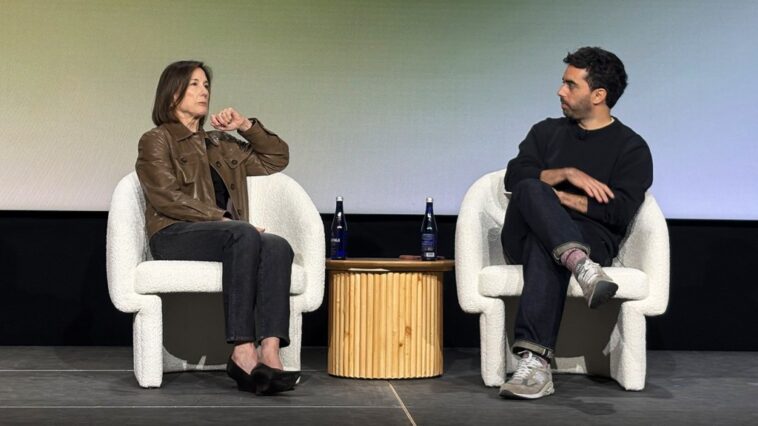
Producer Kathleen Kennedy calls herself a tech optimist and a traditionalist both. At a conference this week, she said the creative community would embrace AI faster if there was more transparency around how it’s trained and how it’s being deployed.
She herself finds it a useful tool but not dramatically so, yet at least. Emotional storytelling, taste, and education (versus learning), ingredients of great film, are still firmly in the human domain, she said during a Q&A at the Runway AI Summit in NYC. She spoke with Cristóbal Valenzuela, Runway’s co-founder and co-CEO.
“Many in the creative community are inherently suspicious of AI. There’s a lot of people trying to experiment because it’s so accessible. But I don’t know to what extent they’re experimenting as deeply as they might be,” wondered the longtime Lucasfilm president, who stepped down earlier this year to produce. “Many of the people that I talk to are still particularly hesitant because what’s missing in the discussion right now is transparency.”
“People feel that there’s a lot they don’t know about what’s going on. So, when there’s conversation around how these language models are being trained, for instance, people are hesitant to talk about the reality of what’s going on. When you reach a point where there’s more transparency in those discussions, and, frankly, more transparency, consequently, around people using these tools, and then there’s an exchange of understanding and common knowledge, then I think that will help greatly.”
Her presence at the confab made sense. Kennedy has actively pursued the intersection of tech and Hollywood over a 50-year career. “I always feel a sense of optimism around using the technology to solve the problem. It’s something that I look for.” In fact, she’s less enthused “when I pick something up and I sort of feel like, okay, I know exactly how we can approach this.”:
That was the case for ET, her first film as a producer, to the Star Wars, Jurassic Park and Indiana Jones franchises, among others. She’s working on Lucasfilm’s next two theatrical releases, The Mandalorian and Grogu and Star Wars: Starfighter.
Kennedy welcomes AI as a new tool in a filmmaker’s kit. “You’re trying to solve the problem. It’s always just that simple. In the case of storytelling, it’s in your imagination, and you try to find a way to visualize it.”
She find AI mostly helpful “for previs [previsualization], planning, preparation, budgeting, scheduling — all the production side of things.” But, “Once you get into execution, then you open up the palette and you have many digital brushes. It might be AI tools. It will be tools that exist today.”
What she likes about AI: “I think it catches up with the flow of creativity and ideas, and the ability to have ever changing, evolving ideas and to realize those, even if they’re not in final form, as quickly as the conversation is going on.”
“You can have a great production meeting and then two days later, everybody comes back and goes, I don’t think those ideas were quite as good as we thought they were. And you’re rethinking and redesigning things … and AI tools actually may help with that process.”
But it’s the human-generated “strong, emotional storytelling” that’s the most difficult thing to get right.”
An issue that’s surfaced more frequently in creative conversations around AI, is taste. “How are you going to teach taste?” she asked. “Because taste is so fundamental to the process of creating things. And that doesn’t mean that one person’s definition of taste is the same as somebody else. But it does define the choices that you’re making along the way.”
“I’m going to sound like a traditionalist because I have a deep appreciation for learned experiences that then contribute to the collaboration and creative process. Like when we’re working with a composer. If you know that somebody’s classically trained, but they’re still doing a very modern score, you’re just going to get a depth to the decision-making along the way that I think is really valuable.”
“I also think it’s education. For years, some of the best directors of photography came out of art. They studied art. And lighting. Lighting is one of the trickiest pieces of art in that it permeates everything we do in special effects. It permeates everything we do in production. It has everything to do with what feels authentic and real and lived in.”
Jurassic Walk
Looking back, Kennedy recalled Steven Spielberg’s E.T. The Extra-Terrestrial from 1982. “CGI wasn’t quite there yet. We made the decision to do that all with puppeteers. There are often 20 people behind a curtain, over tables and whatnot, on that movie.”
For Indiana Jones, “We traveled all over the world. There were three or four years in between each of the movies and that’s kind of a perfect example of where the evolution of technology really began to impact them. We’re using a lot of practical effects, and optical effects. And with each movie, we were pushing the technology. And in between, George [Lucas] was doing Star Wars, so we were having conversations … about what he was discovering.”
“So we were ready to do a movie like Jurassic Park,” Spielberg’s 1993 megahit, recalling the process of trying to develop a giant dinosaur to run in real time across a sound stage. “We’re using stop-motion, we’re using very advanced puppeteering, cell robotics. And we were not having a lot of success. I remember we had some of the guys from the parks helping us, and they figured out how to get at least one leg going. Dennis Muren, senior VX supervisor at ILM, had taken a six-month hiatus and was hell bent on just focusing on this particular problem.”
Muren, with ILM computer engineer and animator at the time Steve Williams, “came back while we’re in the middle of pre-production with a wire frame that had about 40 points of movement that ran across the screen. And it was so groundbreaking. We all leapt to our feet. It was one of those amazing moments where you’re like, okay, that just changed everything.”


GIPHY App Key not set. Please check settings